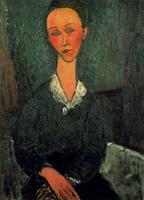
The portrait Young Servant Girl (c. 1918–1919) by Amedeo Modigliani exemplifies the artist’s mature Expressionist idiom, a synthesis of elongated, mask-like features and subtle psychological depth. The work’s significance lies in how Modigliani elevates a working-class subject—likely a domestic employee in his circle—through the same formal dignity he afforded his more famous sitters. The figure’s almond-shaped, vacant eyes, sinuous neck, and simplified planes recall both African tribal masks and the elongated Madonnas of Italian Gothic painting, yet the subtle asymmetry of the face and the soft modulation of flesh tones convey an intimate, melancholic presence. By stripping away narrative detail and focusing on pure line and contour, Modigliani transforms the servant girl into a timeless archetype of human vulnerability. This portrait stands as a testament to his radical ability to merge Expressionist emotion with classical composure, making the ordinary profoundly monumental.