Analisi esperta di Sleeping Venus and Cupid di Nicolas Poussin
Stile: Classicism · Genere: mythological painting
Expert Analysis: Sleeping Venus and Cupid by Nicolas Poussin
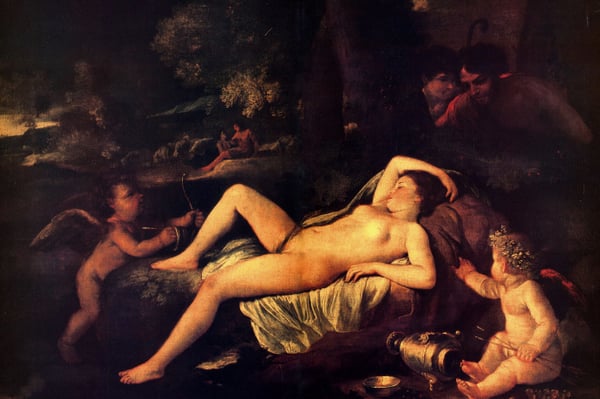
This mythological painting by Nicolas Poussin, executed in the mid-17th century, exemplifies the principles of French Classicism at their most refined. The subject—the goddess Venus reclining in slumber while her son Cupid watches over her—is drawn from ancient literary and visual traditions, yet Poussin transforms it into a meditation on order, harmony, and restrained sensuality.
Composition and Style Poussin arranges the figures with geometric clarity: Venus’s body forms a gently sloping diagonal that echoes classical sarcophagus reliefs, while Cupid’s upright pose creates a counterbalancing vertical. The pyramidal grouping is stable and self-contained, a hallmark of Classicism that prioritizes intellectual design over naturalistic spontaneity. The landscape background is equally disciplined—trees, sky, and architecture are rendered as idealized, almost stage-like settings that frame the figures without distracting from them.
Significance within Classicism What makes this work significant is how Poussin reconciles a traditionally erotic subject with classical decorum. Unlike the overtly sensual Venuses of the Baroque (e.g., Titian’s or Giorgione’s sleeping goddesses), Poussin’s Venus is chaste, her sleep suggesting a dreamlike, unattainable purity. The painting embodies the classicist belief that art should appeal to the mind through rational structure rather than merely to the senses. Poussin’s careful handling of light—soft, even, and devoid of dramatic chiaroscuro—further emphasizes clarity and calm.
Mythological and Intellectual Depth The presence of Cupid, awake but calm, introduces a narrative of love’s watchfulness. Yet Poussin avoids overt emotionalism; instead, the scene feels suspended in timeless stillness. This aligns with the classicist ideal of ut pictura poesis (as is painting, so is poetry)—the work is meant to be “read” as a philosophical allegory of love, beauty, and repose.
Legacy Sleeping Venus and Cupid is a touchstone for Poussin’s mature style and a model for later classicist painters such as Ingres and David. Its significance lies in its demonstration that mythological painting can achieve moral and intellectual gravity through formal rigor—a key contribution of French Classicism to the history of Western art.
Museum / Gallery
Visivamente simili
20 opere con composizione e palette affini
Cimon and Iphigenia
Joshua Reynolds
Danae
Titian
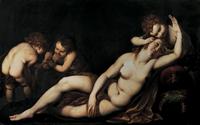
Venus and Cupid
Giulio Cesare Procaccini
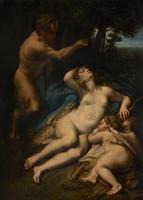
Jupiter and Antiope
Correggio
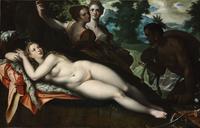
Diana Resting After the Hunt
Bartholomeus Spranger
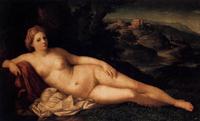
Venus
Palma Vecchio
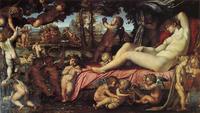
Sleeping Venus
Annibale Carracci
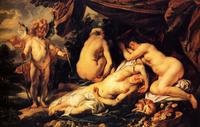
Love of Cupid and Psyche
Jacob Jordaens
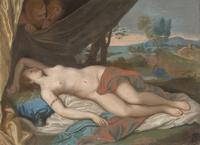
Sleeping nymph spied by satyrs (after a painting based on a print by Anthony van Dyck)
Jean-Étienne Liotard
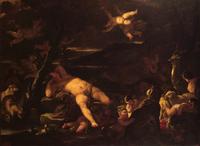
Young Bacchus Sleeping
Luca Giordano
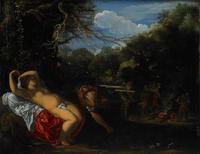
Apollo and Coronis
Adam Elsheimer
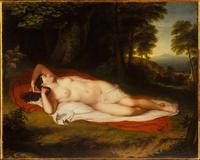
Ariadne
Asher Brown Durand
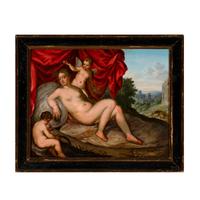
Venere e Amore
Hans Rottenhammer I
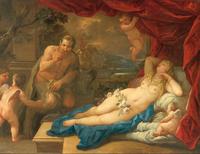
Jupiter and Antiope
Luca Giordano
Baigneuse endormie
Theodore Chasseriau
Venus and Mercury
Nicolas Poussin
Education of Jupiter
Jacob Jordaens
Venus and Amor
Maerten van Heemskerck
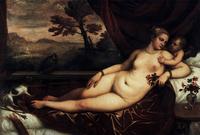
Venus and Cupid
Titian
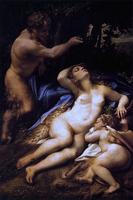
Venus, Satyr and Cupid
Correggio