
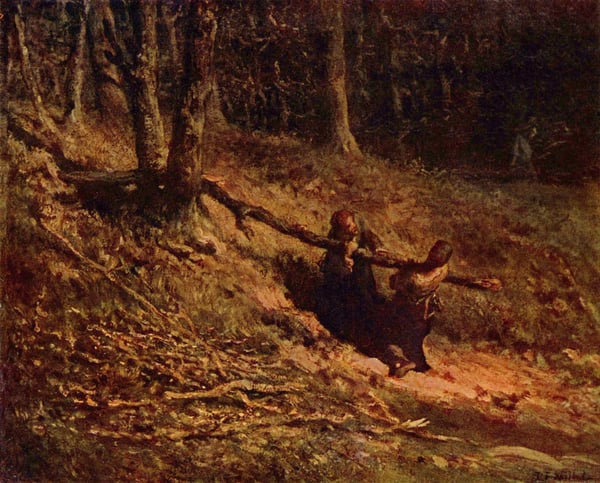
Expert analysis of Jean-Francois Millet’s Brushwood collectors
Style: Realism · Genre: genre painting
Jean-François Millet’s "Brushwood Collectors" stands as a quintessential example of Realism, a mid‑19th‑century movement that broke decisively with the idealized, mythological, or historical subjects favored by the Académie des Beaux‑Arts. Instead, Millet turned his unflinching eye to the hardships and quiet dignity of the French rural peasantry, elevating genre painting to a vehicle for social commentary and profound human empathy.
Significance within the Realist movement:
-
The dignity of manual labor: Millet’s peasants are neither romanticized nor degraded; they are shown as monumental, timeless figures engaged in the backbreaking task of gathering brushwood. The composition (likely a frieze‑like arrangement) and the use of earthy, muted tones ground the scene in the physical reality of toil, challenging the era’s conventional hierarchy that placed grand‑history painting far above scenes of everyday life.
-
Social consciousness: By focusing on the poorest members of rural society—those who must scavenge for firewood—Millet directly confronted the urban bourgeoisie with the inequities of modern agrarian life. "Brushwood Collectors" belongs to a series of works (alongside The Gleaners and The Angelus) that humanized the invisible workforce, making visible the backbreaking labor that sustained France.
-
Formal innovation within genre painting: Unlike earlier genre scenes that often carried moralizing or sentimental overtones, Millet’s approach is starkly observational. His brushstroke emphasizes texture—rough bark, worn clothing, the dry earth—and his figures are often silhouetted against low horizons, imbuing them with a sculptural, almost heroic presence that was revolutionary for a subject previously considered merely anecdotal.
Within Millet’s own oeuvre:
"Brushwood Collectors" exemplifies his shift from biblical and mythological scenes (early in his career) to the peasant subjects that would define his legacy. It is a direct precursor to his most famous work, The Gleaners (1857), and demonstrates his belief that the struggles of ordinary people were as worthy of monumental art as any king or saint.
In sum, the painting is significant because it redefines Realist genre painting: not as a picturesque glimpse of rustic life, but as a solemn, unsentimental record of human endurance—a quiet protest against economic inequality, and a celebration of the resilience of the laboring poor.
Museum / Gallery
Visually similar
20 works with related composition and palette
Hearts of Oak
David Bates
The Sere and the Yellow Leaf
Joseph Farquharson
Death and the woodcutter
Jean-Francois Millet
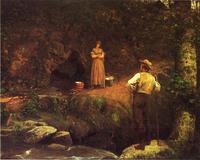
The Early Lovers
Eastman Johnson
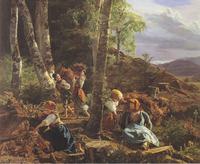
rushwood collectors in the Wienerwald
Ferdinand Georg Waldmüller
At Djurgården in Stockholm
Christian Ezdorf
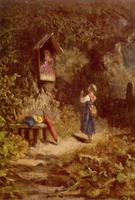
Praying peasant girl in the woods
Carl Spitzweg
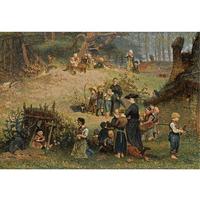
The Saint Joris guild in Dongen
August Allebé
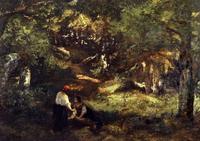
In the Fontainebleau Forest
Narcisse-Virgilio Diaz

Bathing nymphs
Carl Spitzweg
Taking out the Thorn
William Collins
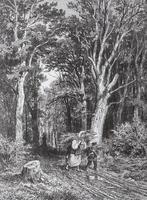
The road in forest
Ivan Shishkin
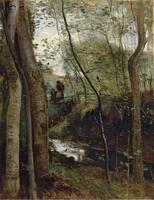
Stream in the Woods
Camille Corot
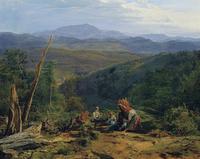
Vienna Woods Landscape With Wildegg Castle
Ferdinand Georg Waldmüller
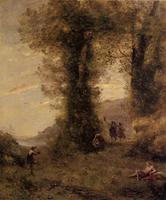
Pastorale
Camille Corot
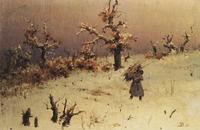
A soldier with a bundle of firewood
Vasily Polenov
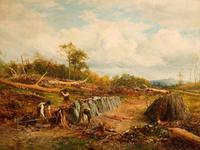
Stacking the Oak Fence
David Bates
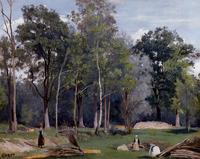
In the Woods at Ville d'Avray
Camille Corot
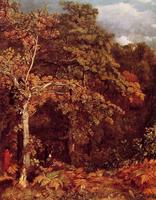
Wooded Landscape
John Constable
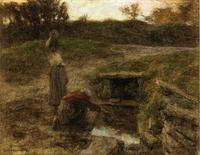
Women at the fountain
Léon Augustin Lhermitte