Expert analysis of Jean-Francois Millet’s Puy de Dôme
Style: Realism · Genre: landscape
Expert Analysis of "Puy de Dôme" by Jean-Francois Millet
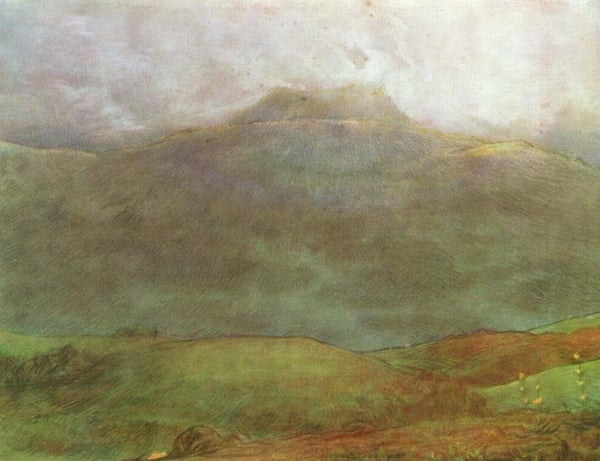
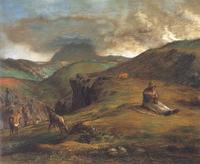
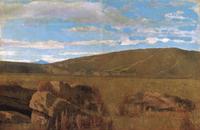
As a landscape painted within the Realist tradition, Puy de Dôme represents a significant departure from the romanticized or heroic landscapes prevalent in the early 19th century. Jean-Francois Millet, best known for his monumental depictions of peasant laborers (e.g., The Gleaners, The Angelus), here turns his attention to the geological and atmospheric reality of a specific French landmark—the volcanic peak of Puy de Dôme in the Auvergne region.
Significance within Realism and Millet’s Oeuvre:
-
Grounding in Topographic Truth: Unlike the idealized pastoral scenes of the Barbizon school or the dramatic, sublime landscapes of Romanticism, Millet’s Puy de Dôme anchors itself in observable, specific topography. The painting does not exaggerate the mountain’s height or cloak it in myth; instead, it presents a solid, volumetric mass rendered with careful attention to light, shadow, and the texture of the earth. This aligns with Realism’s core principle of depicting the world as it is, without emotive or narrative embellishment.
-
The Dignity of the Land Itself: While Millet’s human figures often carry a weight of stoic dignity, in Puy de Dôme the land itself becomes the subject of that same quiet reverence. The painting strips away human presence entirely, focusing on the raw, enduring form of the volcano. This is a radical gesture for an artist whose reputation was built on rural laborers—it asserts that nature, untamed and unpeopled, is equally worthy of the Realist’s serious, unidealized gaze.
-
Atmospheric Naturalism: The work likely employs a subdued, earthy palette and soft, diffuse light, characteristic of Millet’s later landscapes. This treatment of atmosphere—the play of clouds, the haze of distance, the weight of the sky—demonstrates a meticulous observation of weather and time of day. Such attention was crucial to the development of landscape realism, influencing later artists like Jean-Baptiste-Camille Corot and even the early Impressionists, who would push this atmospheric observation further.
-
Counterpoint to Human-Centric Realism: Most Realist landscapes of Millet’s era (e.g., those by Gustave Courbet) often included figures, or at least evidence of human intervention (fields, paths, villages). Puy de Dôme’s focus on a pure, uninhabited geological formation makes it a bold statement: Realism could command the same seriousness for a mountain as for a peasant. It underscores the movement’s breadth, proving that “truth” in art extends from the human condition to the very structure of the earth.
In summary, Puy de Dôme is significant because it expands Realism’s domain from social commentary and rural labor to the direct, unadorned study of nature’s own architecture. It reveals Millet as not only a chronicler of peasant life but also a profound observer of the land itself—a precursor to the plein-air naturalism that would flourish later in the century.
Visually similar
20 works with related composition and palette
Mountain Stream, Coniston
J.M.W. Turner
Туманы на Сенеже
Bantikov Vladimir Andreevich
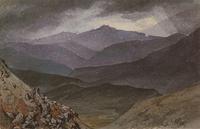
The road in the Sinai after the storm
Karl Bryullov
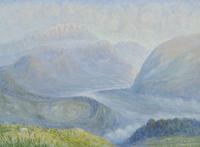
East Sayan. Munko-Sardyk
Mikhail Olennikov
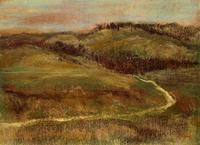
Landscape
Edgar Degas
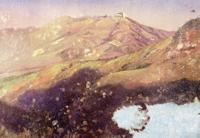
Paisaje con montañas
Jose Maria Velasco
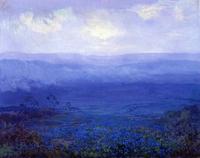
Bluebonnets in Texas
Robert Julian Onderdonk
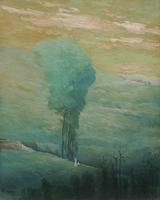
On the Hillside
Leon Dabo
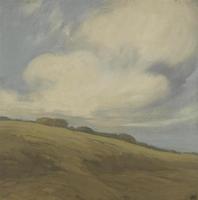
Clouds over a California hillside
Xavier Martinez
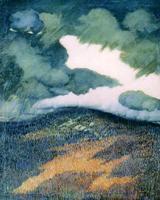
Storm Clouds, Maine
Marsden Hartley
Deluge (VIII)
Mikalojus Konstantinas Ciurlionis
Sunrise in Tumanyan
Martiros Sarian
Puy de Dôme
Jean-Francois Millet
Cloud over the mountain valley
Arkhyp Kuindzhi
Sonnenuntergang Auf Der Mendel
Albin Egger-Lienz
Delphi Valley
Karl Bryullov
Storm by a Lake
Pierre-Henri de Valenciennes
View of mountains, Auvergne
Theodore Rousseau
Vallata a Castiglioncello
Giuseppe Abbati
After a Rain. Rainbow
Arkhyp Kuindzhi