
Analisi esperta di The Winnower di Jean-Francois Millet
Stile: Realism · Genere: genre painting
Expert Analysis: "The Winnower" by Jean-François Millet
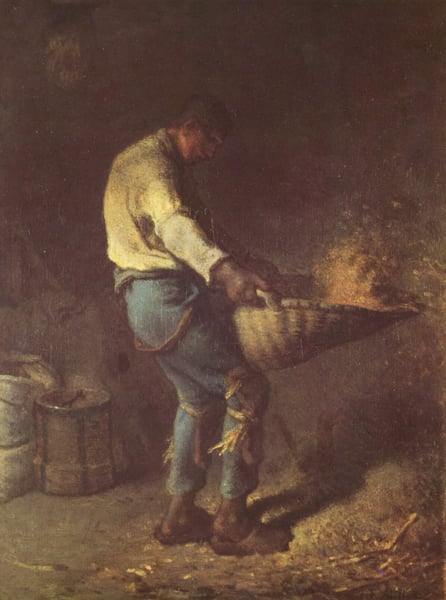
Jean-François Millet’s The Winnower (ca. 1847–48) stands as a foundational work of the Realist movement and a landmark in the genre painting tradition. Executed in oil, the painting depicts a peasant laborer vigorously winnowing grain—separating chaff from wheat—against a dim, indeterminate background. At first glance, it is a simple scene of rural toil, yet its significance lies in Millet’s radical reimagining of such labor as a subject worthy of monumental, heroic treatment.
Context and Realist Innovation
In the mid‑19th century, French academic painting still prized history, mythology, and idealized pastoral scenes. Millet broke with this tradition by focusing not on a noble farmer or a classical allegory, but on an anonymous worker engaged in arduous, repetitive work. The figure is not sentimentalized or romanticized; his bent posture, the tension in his arms, and the heavy, granulated texture of the painted surface convey the physical strain of the task. The stark, almost monochromatic palette and dramatic chiaroscuro (influenced by Millet’s study of Chardin and the Le Nain brothers) emphasize the dignity and solemnity of the moment, rather than any picturesque charm.
Significance within Genre Painting
Genre painting had long depicted everyday life, but often with a moralizing or anecdotal edge. Millet elevates genre by stripping away narrative and focusing on the act itself. The winnower is isolated against a neutral ground, his silhouette dominating the canvas; this compositional choice transforms a humble task into an iconic, almost sculptural image. The work also reflects Millet’s deep empathy for the rural poor—a theme that would later culminate in The Gleaners (1857). In The Winnower, he asserts that the lives of peasants contain as much gravity, struggle, and human truth as any historical or mythological scene.
Lasting Impact
The Winnower was first shown at the 1848 Salon, a revolutionary year in France, and it resonated with contemporary audiences who were increasingly aware of social inequities. The painting influenced subsequent Realists such as Gustave Courbet and, later, the Barbizon school’s turn toward landscape and rural life. More broadly, Millet’s insistence on portraying labor with unflinching honesty paved the way for later social realist movements and modernism’s interest in the unadorned human condition.
In sum, The Winnower is significant because it redefines genre painting as a vehicle for profound social commentary and artistic gravity, marking a decisive break from academic idealization and establishing Millet as a champion of Realist principles.
Museum / Gallery
Visivamente simili
20 opere con composizione e palette affini
Scene in a Cellar
Giuseppe Maria Crespi
Sense of Smell
Adriaen van Ostade
Village Feast
Adriaen van Ostade
Death and the woodcutter
Jean-Francois Millet
Corn Husking
Eastman Johnson
The Sower
Jean-Francois Millet
Threshing the Gleanings
Ralph Hedley
Smokers in a Tavern
Cornelis Pietersz. Bega
Inn Scene
Adriaen van Ostade
A Boor Asleep
Adriaen Brouwer
Interior of a Tavern
Adriaen van Ostade
Lovers Observed
George Morland
Peasants Drinking and Making Music in a Barn
Adriaen van Ostade
The Threshing Floor
Ralph Hedley
Peasant Inn
Adriaen Brouwer
In the Tavern
Adriaen Brouwer
The Stoker
Mykola Yaroshenko
Lean Kitchen
Jan Steen
Peasants Fighting
Adriaen Brouwer
Interior of a Tavern
Adriaen Brouwer