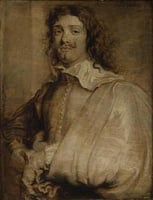
Analisi esperta di Peasant Inn di Adriaen Brouwer
Stile: Baroque · Genere: genre painting
Expert Analysis: "Peasant Inn" by Adriaen Brouwer
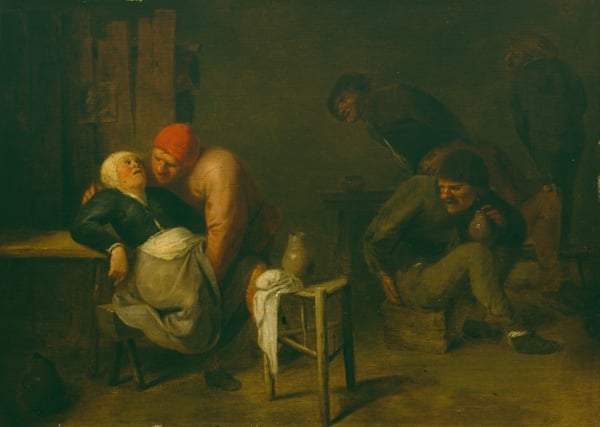
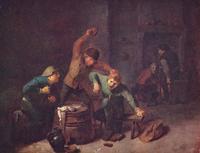
Adriaen Brouwer’s "Peasant Inn" stands as a masterful example of Baroque genre painting, yet it subverts the period’s grand, heroic tendencies by focusing on the gritty, unvarnished reality of common life. Brouwer was a pioneer of the boerenstukken (peasant scenes) that flourished in Flemish and Dutch art, and this work encapsulates his signature approach: raw, intimate, and psychologically acute.
Significance within the Baroque Style: While Baroque art often glorified religious ecstasy, aristocratic power, or dramatic mythology, Brouwer turned his lens to the tavern—a space of crude humor, drunkenness, and unrefined humanity. His palette is deliberately muted, dominated by earthy browns, grays, and ochres, which create a smoky, dim interior. The light is not the divine, theatrical spotlight of Caravaggio but a murky, natural glow that picks out weathered faces and chipped clay mugs. This low-key lighting reinforces the scene’s authenticity, emphasizing the textures of tattered clothing and rough wooden furniture over idealized beauty.
Genre Painting as Social Documentary: Brouwer’s significance lies in his unflinching realism. Unlike earlier peasant scenes that caricatured or romanticized rural life, "Peasant Inn" captures authentic gestures and expressions. Figures are shown mid-argument, laughing, or dozing with slack jaws—none are posed. Brouwer observed his subjects with almost anthropological precision, recording the effects of tobacco smoke, cheap ale, and exhaustion. His brushwork is loose and vigorous, matching the chaotic energy of the inn; faces are built with quick, sure strokes that convey emotion without over-polishing.
Influence and Legacy: Brouwer’s approach deeply influenced later masters like Jan Steen and David Teniers the Younger, who adopted his intimate scale and unpretentious subject matter. Yet Brouwer’s works retain a particular edge: a sense that these peasants are not merely quaint but flawed, resilient, and fully human. "Peasant Inn" is therefore significant not only as a technical achievement of the Baroque—its mastery of light, texture, and composition—but as a bold statement that the sublime could be found in a tavern’s smoke-filled gloom.
Museum / Gallery
Visivamente simili
20 opere con composizione e palette affini
Peasants Smoking And Drinking
Adriaen Brouwer
Interior with Smokers
Adriaen Brouwer
Village barbershop
Adriaen Brouwer
Marriage Contract
Jan Steen
The Smokers or The Peasants of Moerdijk
Adriaen Brouwer
Lean Kitchen
Jan Steen
Interior with Card Players
David Rijckaert III
The Hustle Cap
David Teniers the Younger
Inn Scene
Adriaen van Ostade
The Schlachtfest
Adriaen Brouwer
A man and woman smoking a pipe seated in an interior with peasants playing cards on a table
David Teniers the Younger
Peasants Drinking and Making Music in a Barn
Adriaen van Ostade
Figures Gambling in a Tavern
David Teniers the Younger
Dancing Couple and Merry Company in an Interior
Adriaen van Ostade
Escape of Grigory Otrepyev from inn on the Lithuanian border
Grigoriy Myasoyedov
Smokers in a Tavern
Cornelis Pietersz. Bega
Smokers in an Interior
David Teniers the Younger
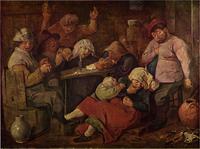
Inn with drunken peasants
Adriaen Brouwer
Smallholders Playing Cards
Adriaen Brouwer
Fat Kitchen
Jan Steen