Expertenanalyse zu Jean-Francois Millets Young woman
Stil: Realism · Genre: genre painting
Expert Art-Historical Analysis: "Young Woman" by Jean-François Millet
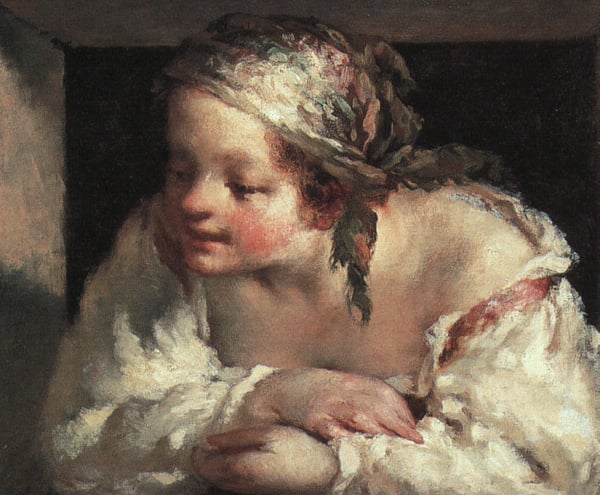
Jean-François Millet’s "Young Woman" is a quintessential example of his commitment to Realism—a mid-19th-century movement that rejected the idealized, mythological, and aristocratic subjects of academic art in favor of honest, unvarnished depictions of everyday life. As a genre painting, it focuses on a single, humble figure, yet it carries profound significance through its quiet dignity and social commentary.
Composition and Style
Millet portrays the young woman in a simple, unadorned setting, likely a rural interior or farm environment. Her pose is natural and unselfconscious, her gaze downcast or engaged in a mundane task—common motifs for the artist. The palette is subdued, grounded in earth tones: browns, grays, and muted ochres, with soft, diffused light modeling her form. This lack of dramatic chiaroscuro or vibrant color aligns with Realism’s rejection of theatricality. Millet’s brushwork is deliberate and tactile, emphasizing the texture of her clothing and the roughness of her hands, suggesting labor.
Significance within Realism
Millet was a central figure in the Barbizon School and a pioneer of Realist subject matter. Unlike his contemporary Gustave Courbet, who often used monumental scale to assert the importance of common people, Millet achieved similar gravity through intimacy and empathy. "Young Woman" is significant because it elevates an anonymous rural figure to the status of a serious artistic subject—a radical act in an era when the Paris Salon favored history painting and allegory. The painting embodies the Realist credo that the lives of peasants, laborers, and women of modest means were worthy of profound attention.
Social and Historical Context
Millet painted during a time of rapid industrialization and rural displacement in France. His works, including "Young Woman," served as a visual counterpoint to urban modernity, preserving the quiet endurance of agrarian life. The young woman’s expression is neither sentimentalized nor heroicized; she is simply present, her existence a testament to resilience. This refusal to idealize—while still conveying a sense of quietude and strength—was Millet’s hallmark and a direct challenge to both Romanticism’s emotional excess and Neoclassicism’s rigid perfection.
Artistic Legacy
The painting’s significance also lies in its influence on later artists. Vincent van Gogh, in particular, revered Millet and copied several of his works, finding in his earthy palette and solemn figures a model for expressing the sublime in the ordinary. "Young Woman" encapsulates the democratic vision of Realism: that beauty and profundity are not the exclusive domain of gods, kings, or saints, but can be found in the bent back of a peasant or the quiet face of a young woman at work.
In summary, Millet’s "Young Woman" is not merely a portrait of an individual but a manifesto of Realist principles: the celebration of human dignity, the rejection of artifice, and the belief that art’s highest calling is to see truth in the everyday.
Museum / Gallery
Visuell ähnlich
20 Werke mit ähnlicher Komposition und Farbpalette
Girl in the Window
Rembrandt
Young italian woman
Adolphe Piot
Portrait of a young girl
Vincenzo Irolli
Sister Sarah
Henry Ossawa Tanner
Portrait of a peasant woman
Giovanni Segantini
A Woman Weeping
Rembrandt
Peasant Woman Peeling an Orange
Mary Cassatt
Woman's Head
Francois Boucher
Young Girl at the Window
Rembrandt
A Young Scholar
Jean-Honore Fragonard
Young mother sleeping next to her baby
Ernst Meyer
Cleopatra
Guido Reni
Portrait of a Girl Reading
Thomas Sully
Portrait of a little girl
Ludwig Knaus
Nymph
Arnold Böcklin
Woman Looking for Fleas
Giuseppe Maria Crespi
The Holy Family(fragment)
Rembrandt
The Sleeping Seamstress
Jean-Francois Millet
The morning meal
Noè Bordignon
Girl with Birds
Jean-Baptiste Greuze