Expert analysis of Victor Borisov-Musatov’s Garlands of Cornflowers
Style: Post-Impressionism · Genre: landscape
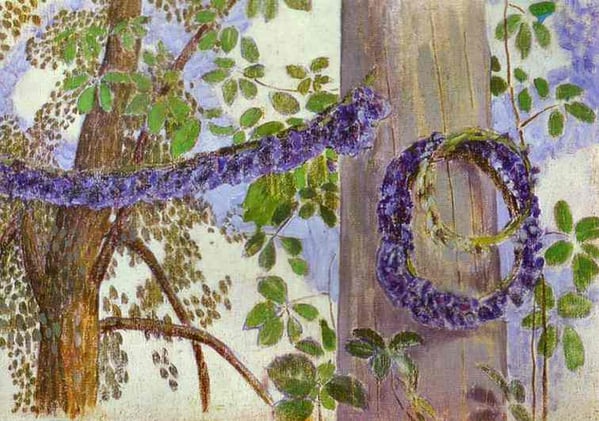
Victor Borisov-Musatov’s "Garlands of Cornflowers" is a quintessential example of the artist’s deeply personal synthesis of Post-Impressionist color sensibility with a Symbolist atmosphere, marking a pivotal moment in Russian landscape painting. Although classified as a landscape, the work transcends simple topographical representation by imbuing the natural scene with a dreamlike, melancholic lyricism.
Borisov-Musatov was a master of tonal harmony and decorative surface, and this painting demonstrates his signature approach: a muted, almost autumnal palette dominated by soft blues, silvers, and faded greens, punctuated by the vibrant yet delicate blues of cornflowers. The “garlands” are not merely floral accents but become a structuring motif, weaving nature into a pattern that borders on the abstract. This decorative, rhythmic handling of the landscape links him to the Post-Impressionist preoccupation with flatness and pattern, while his evocation of a vanished, idyllic past aligns him with Russian Symbolism.
What makes "Garlands of Cornflowers" significant is its quiet rebellion against both naturalistic representation and overt narrative. Borisov-Musatov refuses to treat the landscape as a mere backdrop; instead, he transforms it into a stage for memory and melancholy. The absence of human figures—common in his work—turns the viewer’s attention to the land itself as the carrier of emotion. The cornflowers, a traditional Russian symbol of modesty and nostalgia, reinforce a sense of gentle loss.
In the context of Post-Impressionism, this work stands out for its restrained expressiveness. Unlike the bold color strokes of van Gogh or the structural geometry of Cézanne, Borisov-Musatov uses a delicate, almost watercolor-like touch that achieves emotional depth without dramatic contrast. It is a landscape that breathes silence, inviting contemplation rather than visual excitement. This subtlety is what makes "Garlands of Cornflowers" a significant contribution to the transition from 19th-century realism to 20th-century modernism in Russian art.
Museum / Gallery
Visually similar
20 works with related composition and palette
Kwitnące glicynie Wisteria
Edward Okuń
Landscape with a Rainbow
Konstantin Somov
Field of the collective farm
Kateryna Bilokur
Mother and Child in Pergola at Marquayrol
Henri Martin
On a Balcony in Tarusa
Victor Borisov-Musatov
Landscape No. 2 with Bathers
Florine Stettheimer
Kaulbach’s Grab am Frühmorgen des 11. April
Wilhelm von Kaulbach
Hazel Bush
Victor Borisov-Musatov
Bouquet
Pyotr Konchalovsky
A Vase of Irises on the Terrace
Louise Abbéma
A Rose Trellis (Roses at Oxfordshire)
John Singer Sargent
The Trio
Robert Lewis Reid
Flowers and Fruit in a Garden
Eugene Boudin
The Pergola in Marquayrol
Henri Martin
The Bodmer Oak
Claude Monet
A Pergola with grapes
Ernst Meyer
Strange Garden
Józef Mehoffer
View from Capodimonte
Gabriele Smargiassi
Pastoral Scene with Two Girls
Konstantin Somov
The Garden
Eugene Boudin