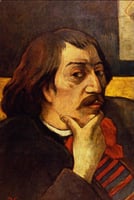
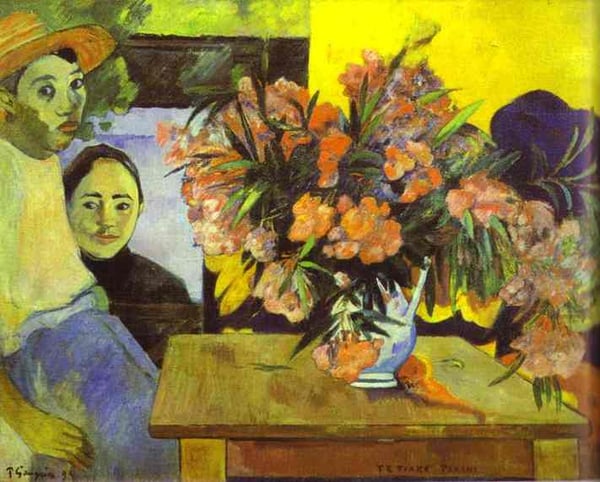
Flowers of France
Details
Expertenanalyse zu Paul Gauguins Flowers of France
Stil: Cloisonnism · Genre: genre painting
Expert Analysis of "Flowers of France" (Paul Gauguin, 1st Tahiti Period)
Paul Gauguin’s "Flowers of France" exemplifies his Cloisonnist style during his first Tahitian sojourn (1891–1893), a period defined by his deliberate rejection of European naturalism in favor of symbolic, flattened forms and vibrant, non-naturalistic color. This work belongs to the genre painting tradition—scenes of everyday life—but Gauguin transforms the ordinary into a mythic, almost ritualistic tableau.
Significance within Cloisonnism and the Tahiti Period:
-
Formal Innovation: The painting employs Cloisonnism’s signature technique—bold, dark outlines (reminiscent of medieval cloisonné enamel or stained glass) that enclose areas of pure, unmodulated color. Figures and forms are simplified into geometric patches, eschewing depth and shadow for a two-dimensional, decorative flatness. This approach aligns with Gauguin’s goal to prioritize emotion and symbolism over optical realism.
-
Cultural Juxtaposition: The title "Flowers of France" introduces a deliberate irony. Set in Tahiti, the “flowers” likely refer to Tahitian women—perhaps posed with blossoms—but the phrase evokes colonial exoticism and the French fascination with the “Edenic” South Pacific. Gauguin contrasts the imported “civilized” flora (or ideals) with the raw, vital forms of Polynesian life, hinting at his critique of European materialism and his search for a primal, unspoiled truth.
-
Syncretic Imagery: Though the exact composition is unknown, Gauguin often combined Tahitian motifs (botanical forms, native cloth patterns, gestures derived from Oceanic art) with Western pictorial structures. The Cloisonnist style enables this fusion: the bright, saturated colors (ochres, greens, pinks) evoke tropical light, while the outlined patches create a tapestry-like rhythm that flattens space into a symbolic, rather than narrative, field.
-
Period Context: This work’s significance is rooted in Gauguin’s radical break from Impressionism. While the earlier Vision After the Sermon (1888) pioneered Cloisonnism in a Breton setting, "Flowers of France" applies the same principles to Tahiti, merging “primitive” subject matter with a deliberately archaic, anti-perspectival technique. It prefigures Gauguin’s later, even more symbolic works like Where Do We Come From? (1897).
In sum, "Flowers of France" is a pivotal example of Cloisonnism’s maturity: a synthesis of the decorative and the philosophical, where Gauguin’s Tahitian “flowers” become emblems of a lost, pre-colonial world—filtered through a European avant-garde lens that permanently changed modern painting.
Museum / Gallery
Visuell ähnlich
20 Werke mit ähnlicher Komposition und Farbpalette
Children of the artist
Boris Kustodiev
Oleanders and Books
Vincent van Gogh
Chapelle Rose
Henri Martin
The Rose Robe
Henri Martin
Pitcher
Pierre Bonnard
Roses and Geraniums on the Terrace at Marquayrol
Henri Martin
Bella in Mourillon
Marc Chagall
The Muse
Henri Martin
Mother and child behind the bouquet of flowers
Pablo Picasso
Still Life Vase with Oleanders
Vincent van Gogh
Self Portrait with Yellow Lilies
Natalia Goncharova
Portrait of a Member of the Artist's Family
Kazimir Malevich
Jeanne with Flowers
Raoul Dufy
Plum Blossoms, Green Background
Henri Matisse
Bela Czobel Still Flover Interior
Bela Czobel
Paris. Azaleas in a pot.
Pyotr Konchalovsky
Girl in White with a Bouquet
Henri Matisse
The Vase of flowers
Pierre Bonnard
The Terrace, St. Tropez
Henri Matisse
The Madras
Henri Matisse