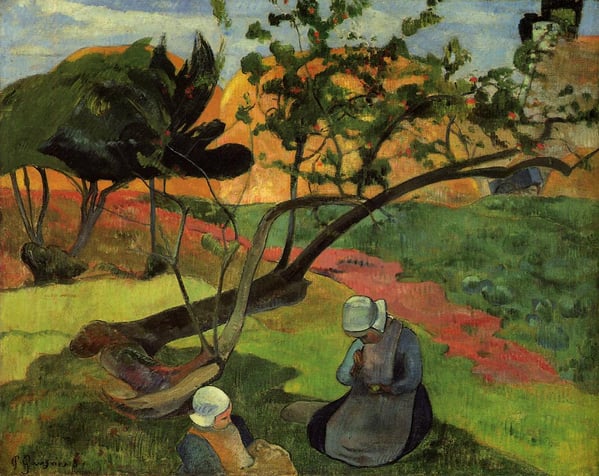
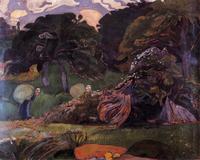
Landscape with two breton women
Dettagli
Analisi esperta di Landscape with two breton women di Paul Gauguin
Stile: Post-Impressionism · Genere: landscape
Expert Analysis: "Landscape with Two Breton Women" by Paul Gauguin
Painted during Gauguin’s formative Breton period (roughly 1886–1891), this work exemplifies his decisive break from Impressionism and his embrace of Post-Impressionism’s core concerns: expressive color, symbolic subject matter, and a flattened, decorative surface. The presence of two Breton women within the landscape is not merely a genre-scene detail but a deliberate emblem of Gauguin’s search for a “primitive” spirituality and a pre-industrial way of life—themes that would dominate his later Tahitian works.
Significance within Post-Impressionism and Gauguin’s Breton Period:
-
Synthesis of Nature and Symbolism
Unlike the Impressionist emphasis on changing light and atmospheric effects, Gauguin organizes the landscape into broad, rhythmic planes of color. The two women are not individualized portraits but archetypes, integrated into the composition as part of the earth’s rhythms. This reflects the Cloisonnist (enamel-like) technique Gauguin developed alongside Émile Bernard in Pont-Aven, where dark outlines contain flat patches of color—a style that prioritizes emotional and symbolic resonance over naturalistic accuracy. -
Breton Identity as Escape from Modernity
In the late 1880s, Brittany was seen by Parisian avant-garde artists as a “primitive” refuge, untouched by industrialization. By placing two local women in a landscape of stark hills and simple cottages, Gauguin transforms the scene into a timeless, almost mythical vision. The women’s heavy, layered costumes and static poses convey a sense of eternal, rural piety—a contrast to the artifice of the capital. -
Color as Emotional Structure
Gauguin pushes Post-Impressionism toward Fauvist intensity in this work, using muted earth tones punctuated by unexpected greens, ochres, and blues. The colors do not describe local reality but instead evoke a mood of solemn tranquility, reinforcing the spiritual bond between the figures and the land.
What Makes It Significant:
This painting marks a pivotal moment when landscape becomes a vehicle for psychological and cultural symbolism. Gauguin’s careful distortion of perspective (the tilted ground, the compressed space) and his reduction of forms to essential shapes prefigure both Symbolism and Expressionism. The work stands as a testament to his conviction that art must transcend mere visual observation—a foundational principle of Post-Impressionism that reshaped Western painting’s trajectory.
In sum, “Landscape with Two Breton Women” is a masterful synthesis of Gauguin’s Breton sojourn: a quiet, radical statement of how place, people, and painterly form could be fused into a single, resonant image.
Museum / Gallery
Visivamente simili
20 opere con composizione e palette affini
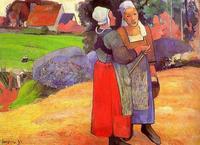
Paysannes bretones
Paul Gauguin
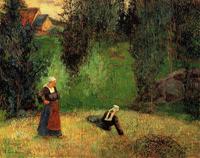
The first flowers
Paul Gauguin
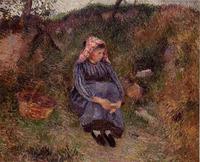
Seated Peasant Girl
Camille Pissarro
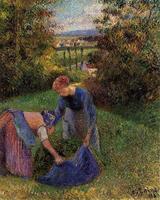
Women Gathering Grass
Camille Pissarro
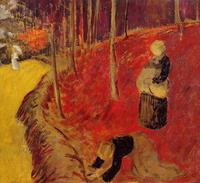
The Fern Harvesters in the Boid d'Amour at Pont Aven
Paul Serusier
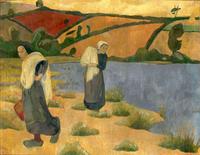
Washerwomen at the Laita River, near Pouldu
Paul Serusier
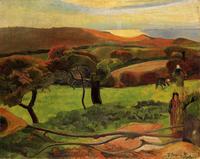
Breton Landscape - Fields by the Sea (Le Pouldu)
Paul Gauguin
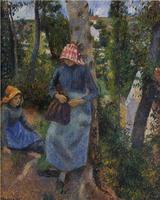
Two Young Peasants Chatting under the Trees
Camille Pissarro
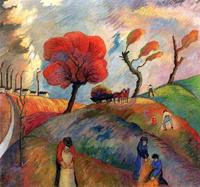
Ant hill
Marianne von Werefkin
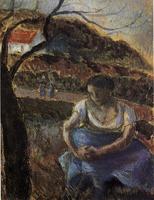
Seated Peasant Woman
Camille Pissarro
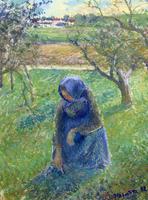
Gathering Herbs
Camille Pissarro
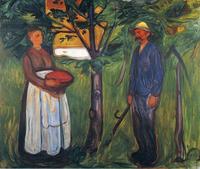
Fertility II
Edvard Munch
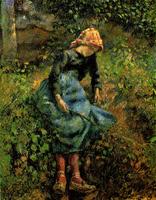
Girl with a Stick
Camille Pissarro
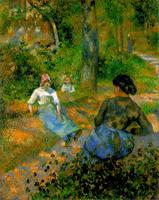
Peasants Resting
Camille Pissarro
Working women (sketch)
Cristiano Banti
Solitude, Huelgoat Landscape
Paul Serusier
Gathering Apples
Jean-Francois Millet
Peasant Woman Carrying a Basket
Camille Pissarro
Brittany landscape with women carrying sack
Paul Gauguin
The red cow
Paul Gauguin