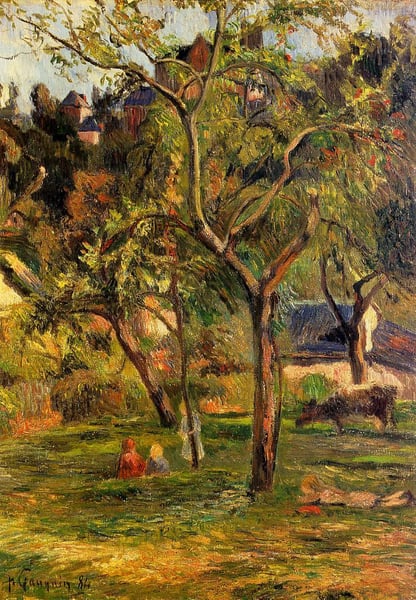
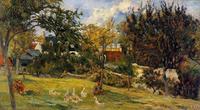
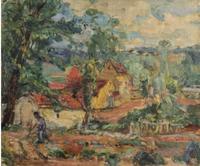
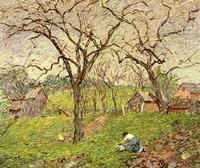
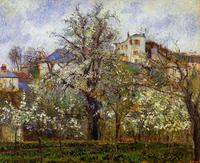
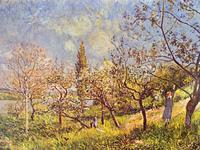
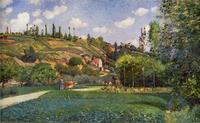
Artwork Analysis: Orchard under the Church of Bihorel (Children in the Pasture) by Paul Gauguin
This early work by Paul Gauguin, executed during his Impressionist phase, is significant as a formative example of his engagement with landscape and rural life before his later, more radical Post-Impressionist and Symbolist departures. Painted in the pastoral setting of Bihorel, the composition aligns with classic Impressionist concerns—capturing the transient effects of light and atmosphere in an open-air scene. Yet even here, Gauguin begins to assert his own sensibility: the inclusion of children in the pasture introduces a narrative, almost idyllic, human element that subtly shifts the focus from pure optical sensation to a more personal, contemplative observation of everyday existence.
The work's historical importance lies in its documentation of Gauguin’s stylistic foundations. Remaining within the Impressionist lexicon of broken brushwork and luminous color, the painting nonetheless hints at the simplified forms and symbolic undercurrents that would define his mature career. For scholars, Orchard under the Church of Bihorel (also known as Children in the Pasture) represents a crucial transition—a moment when Gauguin was still absorbing the lessons of Monet and Pissarro while quietly planting the seeds of his own distinctive vision, which would soon culminate in his groundbreaking Synthetist style and escape to Tahiti. As an early landscape, it offers a rare glimpse of the artist’s roots, grounding his later exoticism in the familiar French countryside.