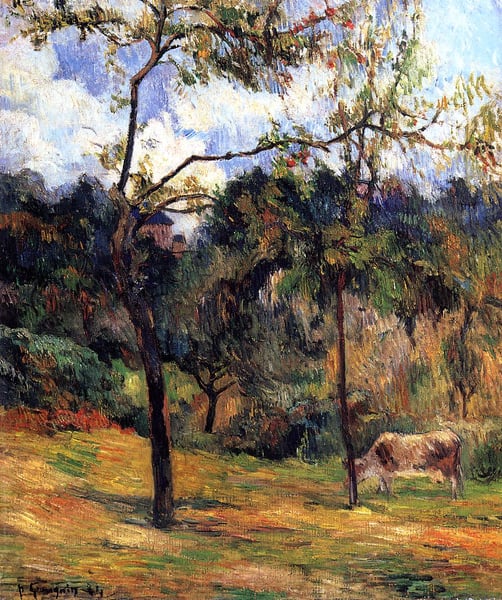
Normandy Landscape: Cow in a Meadow
Detalles
Análisis experto de Normandy Landscape: Cow in a Meadow de Paul Gauguin
Estilo: Impressionism · Género: landscape
Expert Analysis: "Normandy Landscape: Cow in a Meadow" by Paul Gauguin
This early work by Paul Gauguin, painted during his formative Impressionist period, offers a crucial window into the artist's development before his radical break into Post-Impressionism and Symbolism. Executed in the pastoral countryside of Normandy, the painting exemplifies the core tenets of Impressionism—plein air observation, transient light effects, and an emphasis on everyday rural life—while also revealing the nascent tendencies that would later define Gauguin's distinctive vision.
Significance within Impressionism and Gauguin's Early Period:
-
Technical adherence to Impressionist principles: The canvas captures the fleeting atmosphere of a meadow under shifting skies, with loose, visible brushstrokes that break color into dabs and dashes. Gauguin applies paint with a rapid, tactile quality, layering greens, yellows, and cool blues to simulate the dappled play of sunlight and shadow across grass and animal. The cow itself is rendered with simplified contours, its form dissolving into the surrounding vegetation—a hallmark of the Impressionist goal to depict the sensation of a scene rather than its photographic details.
-
Choice of subject and location: Normandy was a favored locale for Impressionists (Monet, Pissarro, and Renoir all painted there), and Gauguin's choice of a humble meadow with a solitary cow aligns with the movement's rejection of historical or mythological grandeur in favor of modern, unspectacular nature. Yet the cow stands as a serene anchor, a motif Gauguin would later revisit in his Breton and Tahitian works, often imbuing animals with symbolic or primitive weight—a hint of his future direction.
-
Color palette and emerging personal style: While the painting is bathed in the characteristic high-key, naturalistic colors of Impressionism (vibrant green grass, pale blue sky, creamy white clouds), there are subtle departures. Gauguin pushes the green of the meadow toward deeper, almost emerald tones, and the cow's brown-and-white hide is touched with lilac shadows—a choice that foreshadows his later use of arbitrary, emotionally charged color. The composition is balanced but unforced, with a low horizon that emphasizes the expanse of sky, a device Gauguin would continue to exploit in his more iconic works.
-
Transitional importance: "Normandy Landscape: Cow in a Meadow" is significant as a document of Gauguin's apprenticeship. In the early 1880s, he was still a stockbroker-turned-painter learning from Pissarro, and this work shows his competent, even dutiful, adoption of Impressionist technique. Yet the careful structuring of the landscape—the strong diagonal of the fence line, the flatness of the cow's silhouette—anticipates his mature interest in pattern, the synthetic use of form, and the flattening of pictorial space that would culminate in his Pont-Aven period.
For viewers and scholars, this painting offers a rare glimpse of Gauguin working within the orthodoxy of Impressionism before he shattered it. It demonstrates that his revolutionary vision did not emerge ex nihilo but grew from a deep understanding of the movement's core concerns: light, atmosphere, and the direct observation of nature. In this quiet meadow, we see the future Gauguin beginning to stir beneath the surface of Impressionist convention.
Museum / Gallery
Visualmente similares
20 obras con composición y paleta relacionadas
Two cows in the meadow
Paul Gauguin
Orchard under the Church of Bihorel (Children in the Pasture)
Paul Gauguin
Young woman lying in a grass
Paul Gauguin
Horse and Cow in a Meadow
Paul Gauguin
Autumn Landscape at Goulazon
Maxime Maufra
Almond trees in Asis
Joaquín Sorolla
Apple-Trees in Blossom
Paul Gauguin
The Pear Tree
Pierre-Auguste Renoir
Apple Trees on the Chantemesle Hill
Claude Monet
Cagnes Landscape
Pierre-Auguste Renoir
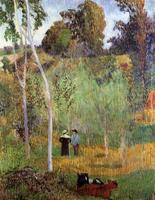
Sheperd and sheperdess in a meadow
Paul Gauguin
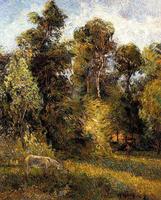
The Forest Edge
Paul Gauguin
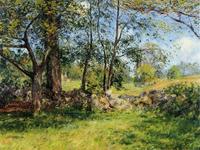
Summer Landscape (Summertime)
Joseph DeCamp
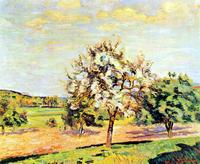
Pommiers en fleurs
Armand Guillaumin
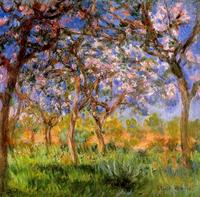
Giverny in Springtime
Claude Monet
The River Meadow at Poduri
Stefan Luchian
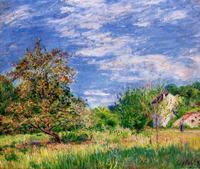
Orchard in Spring
Alfred Sisley
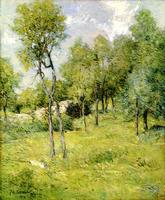
Midsummer Landscape
Julian Alden Weir
Landscape at Grasse
Pierre-Auguste Renoir
Berény Róbert, Zebegényi Táj
Berény Róbert