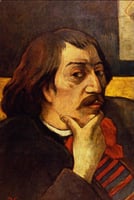
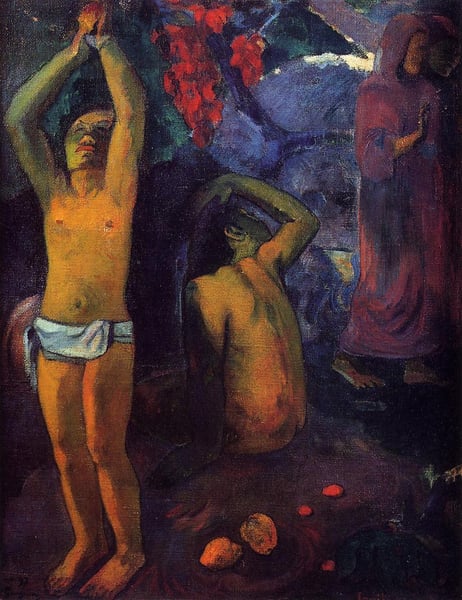
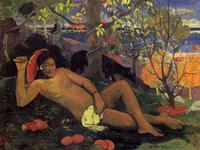
Tahitian Man with His Arms Raised
Dettagli
Analisi esperta di Tahitian Man with His Arms Raised di Paul Gauguin
Stile: Post-Impressionism · Genere: genre painting
Expert Analysis: "Tahitian Man with His Arms Raised" by Paul Gauguin
This work belongs to Gauguin’s second Tahitian period (1895–1903), a phase marked by a deepening engagement with the island’s myths, spirituality, and his own personal mythology. As a Post-Impressionist genre painting, it rejects naturalistic depiction in favor of symbolic content and expressive color.
Significance within the Style and Period:
-
Symbolic Gesture and Spirituality – The raised arms of the Tahitian figure are not merely a naturalistic pose; they evoke a ritualistic or supplicatory gesture. Gauguin often used such motifs to suggest a connection between the human and the divine, reflecting his fascination with Tahitian religion and his own synthesized spirituality. This aligns with his broader project to portray a “primitive” paradise untainted by European materialism.
-
Color and Flatness – Gauguin’s use of broad, unmodulated areas of color—typically deep greens, oranges, and earthy browns—creates a decorative, almost cloisonné effect. The man’s skin is rendered in a warm, exaggerated tone that is not naturalistic but symbolic, emphasizing the figure’s otherness and vitality. This flatness and bold contouring are hallmarks of Post-Impressionism’s move away from Impressionist optical realism toward emotional and symbolic expression.
-
Cultural Hybridity – Painted during his second stay in Tahiti, this work reflects Gauguin’s growing pessimism about colonial intrusion. The gesture can be read as both a greeting and a lament, a body language that Gauguin believed to be authentically Tahitian, even though he often invented or merged symbols from various Polynesian sources. The painting thus embodies the tension between the artist’s romanticized vision and the actual cultural erosion he witnessed.
-
Influence on Modernism – Works like this directly influenced early 20th-century movements—Fauvism (through its radical color) and Primitivism (through its formal simplicity and “otherness”). Gauguin’s flattened, iconic figure breaks with Western academic tradition, pioneering a new visual language that would shape Expressionism and Symbolism.
In sum, Tahitian Man with His Arms Raised is significant not only as a genre scene but as a distilled expression of Gauguin’s anti-colonial primitivism, his synthesis of local symbolism with Post-Impressionist form, and his lasting impact on the course of modern art.
Visivamente simili
20 opere con composizione e palette affini
Bathers
Paul Cezanne
Delectable Waters
Paul Gauguin
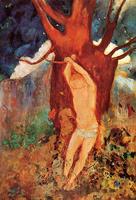
The Martyrdom of Saint Sebastian
Odilon Redon
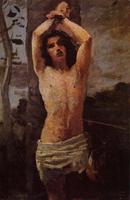
Saint Sebastian
Camille Corot
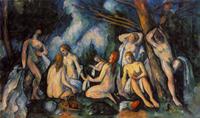
Large Bathers
Paul Cezanne
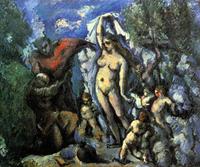
The Temptation of St. Anthony
Paul Cezanne
The Bathers
Paul Gauguin
The Invocation
Paul Gauguin
Bathers at Rest
Paul Cezanne
Adam and Eve
Paul Gauguin
Two girls bathing
Paul Gauguin
Four Bathers
Paul Cezanne
Bathers
Paul Cezanne
Bathers
Honore Daumier
Diana and Actaeon
Zinaida Serebriakova
Bathers
Paul Cezanne
Bathers I
Henri Fantin-Latour
Four Bathers
Paul Cezanne
The King's Wife
Paul Gauguin
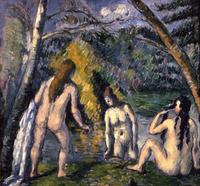
Three Bathers
Paul Cezanne