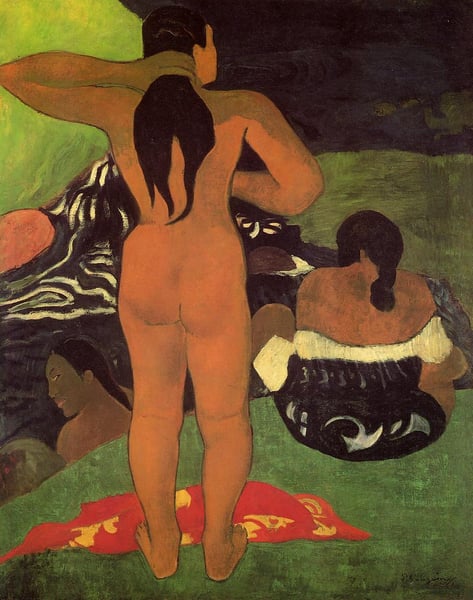
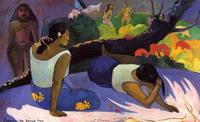
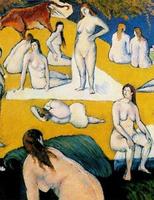
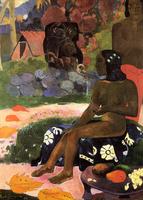
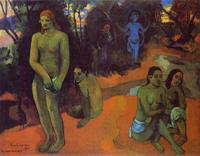
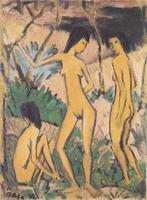
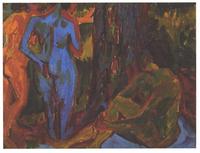
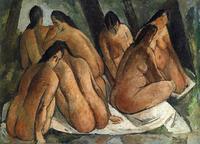
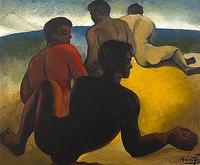
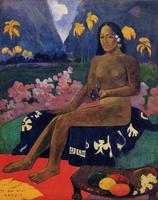
This artwork, "Tahitian women on the beach" by Paul Gauguin, is a seminal genre painting from his 1st Tahiti period (1891–1893). Executed in the Cloisonnism style, it marks a pivotal moment in Gauguin’s career and in the evolution of Post-Impressionism.
The significance of the piece lies in how it synthesizes Gauguin’s stylistic innovations with his new subject matter. Cloisonnism—characterized by bold, dark outlines and flat, unmodulated patches of color—transforms the scene of everyday Tahitian life into a symbolic, almost enamel-like composition. Rather than using naturalistic light and shadow, Gauguin flattens the figures and the beach into a harmonious, decorative plane, rejecting Western perspective in favor of a more primal, symbolic order.
Within the context of his 1st Tahiti period, this work is groundbreaking because it moves beyond mere ethnographic observation. The genre painting format—depicting ordinary women on a beach—becomes a vehicle for Gauguin to express his idealized vision of a ‘primitive’ paradise, free from European conventions. The juxtaposition of the Cloisonnist technique (borrowed from stained glass and Japanese prints) with this “exotic” subject matter underscores his break from Impressionism and his turn toward a more subjective, synthesizing art. This painting thus stands as a key example of how Gauguin used style not just to represent, but to transform reality into a timeless, mythic image.