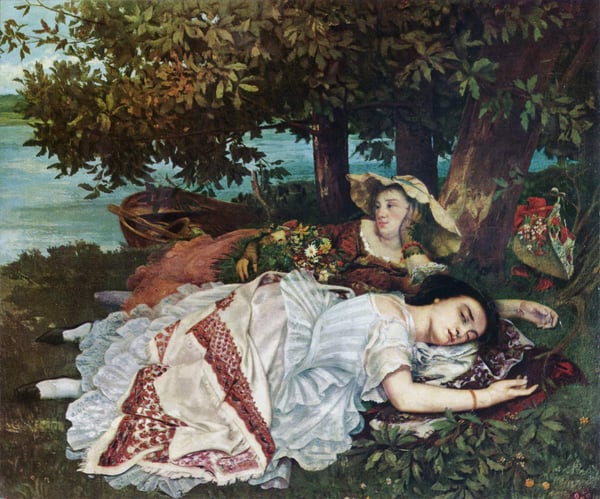
This artwork, Young Ladies on the Banks of the Seine (Summer), is a landmark of the Realist movement. As a portrait—though it functions as a genre scene—Courbet presents two young women lounging by the water, one asleep and the other gazing absently. Their casual, unidealized poses, contemporary dress, and the unglamorous intimacy of the moment directly challenge the classical or mythological conventions of academic painting.
Stylistically, the work embodies Realism’s core principles: a commitment to truth and an unsentimental view of modern life. Courbet refuses to moralize or ennoble his subjects; instead, he captures a slice of mundane leisure with frank observation. The figures are not goddesses or nymphs but ordinary Parisian women, grounded in a specific time and place. This choice was provocative in its era—by treating everyday life with the scale and seriousness traditionally reserved for history painting, Courbet asserts that contemporary existence is worthy of artistic attention.
The painting’s significance lies in its radical rejection of Romantic idealization. The women’s limp postures, the heavy heat of a summer day, and the slightly banal setting of the riverbank all reinforce the Realist goal: to see and depict the world as it is, not as it should be. This work thus stands as a pivotal document of how Realism prioritized authenticity over beauty, paving the way for later modern movements that would continue to dismantle academic hierarchies.