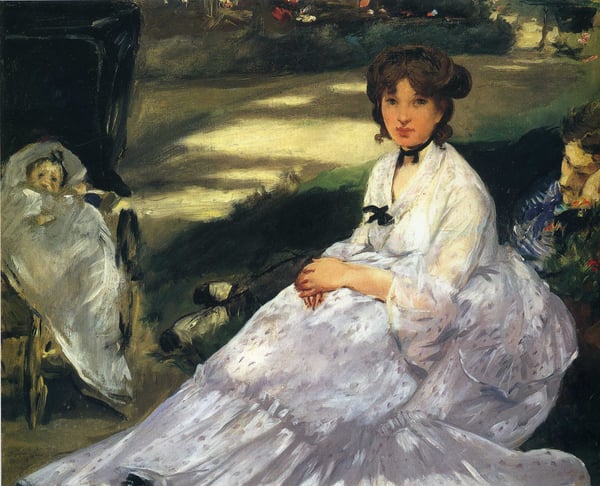
Based solely on the structured facts provided—that the work is “In the Garden” by Édouard Manet, executed in the Impressionist style and belonging to the genre painting category—the following analysis focuses on its significance within these parameters.
As an Impressionist genre painting, “In the Garden” embodies two key innovations that define the movement’s break from academic tradition. First, its genre painting classification places it firmly in the realm of everyday, contemporary life rather than historical, mythological, or religious subjects. This choice reflects the Impressionist commitment to depicting modern leisure and domestic scenes, elevating ordinary moments to subjects worthy of fine art. Second, Manet’s application of Impressionist principles would emphasize spontaneous brushwork, a bright palette, and the play of natural light—capturing a fleeting instant rather than a polished narrative. The significance of this work lies in how Manet, as a pivotal figure bridging Realism and Impressionism, uses the garden setting (a typical Impressionist locale) to explore the interplay of sunlight and shadow on figures and foliage, all while treating the scene with the informal, snapshot-like composition characteristic of the style. In doing so, “In the Garden” contributes to the Impressionist redefinition of painting as an immediate sensory record rather than a moral or historical lesson.