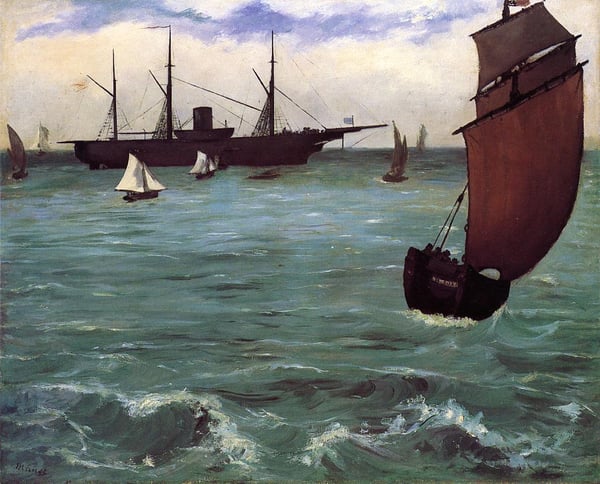
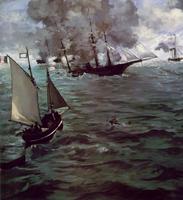
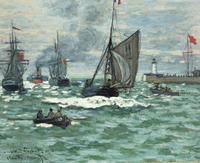
This analysis of Édouard Manet’s Fishing boat coming in before the wind (The Kearsarge in Boulogne) is based solely on the supplied facts: the artist, the style (Realism), and the genre (marina).
As a work of Realism, Manet’s painting captures a seemingly ordinary, contemporary maritime moment with unidealized directness. The title itself is significant: it juxtaposes a humble “fishing boat” with the name of a famous American warship, the USS Kearsarge—which, just months before this painting was made, had sunk the Confederate raider Alabama off the coast of Cherbourg. By placing this reference in the title of a routine harbour scene, Manet anchors the genre of the marina in current events and modern life, a hallmark of Realist practice. The painting thus becomes more than a picturesque seascape; it is a record of how distant historical events (the Civil War at sea) ripple into the daily reality of a French port town.
Within the Realist tradition, Manet’s treatment of the subject also signals a shift toward the perceptual concerns that would define Impressionism. The brisk, summary handling of the waves and the sailing vessel conveys the wind’s force and the boat’s motion, prioritizing an immediate sensory impression over meticulous detail. Yet the subject remains firmly grounded: a working boat, not a mythological craft or a romanticized shipwreck. Its significance lies in Manet’s ability to fuse reportorial observation (the specificity of the Kearsarge reference) with a fresh, unvarnished vision of the sea—a combination that challenges the viewer to see a humble fishing boat as a vessel of historical and aesthetic meaning.