
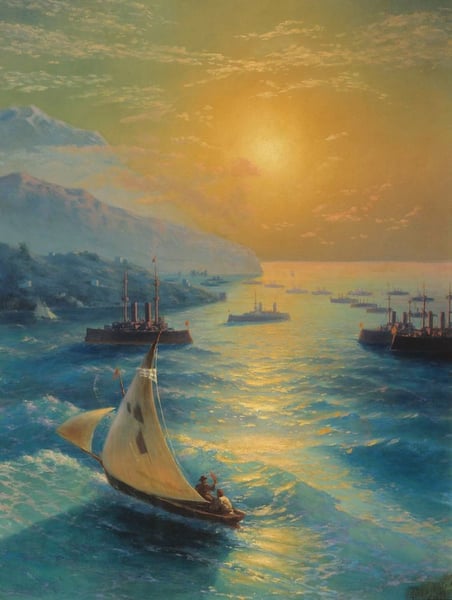
Analisi esperta di Ships at the Feodosiya raid di Ivan Aivazovsky
Stile: Romanticism · Genere: landscape
Expert Art Historical Analysis: "Ships at the Feodosiya raid" by Ivan Aivazovsky
Ivan Aivazovsky’s “Ships at the Feodosiya raid” is a quintessential example of Romantic landscape painting, executed with the dramatic emotional intensity and sublime naturalism that define the Romantic movement. The artwork’s significance lies in how it harnesses the core Romantic preoccupation with the power and beauty of nature—specifically the sea—as a vehicle for human feeling and transcendence.
Mastery of Marine Sublimity
Within the Romantic style, the sea was often depicted as a site of both awe and terror, a boundless force that dwarfed human presence. Aivazovsky elevates this trope by focusing on the harbor of Feodosiya (his hometown in Crimea), transforming a local view into a universal scene of atmospheric grandeur. The “raid” (a sheltered anchorage) becomes a stage where ships—man-made vessels—are integrated into the elemental drama of sky and water. This perfectly embodies Romanticism’s tension between human endeavor and nature’s overwhelming scale.
Luminosity and Atmosphere
Aivazovsky was celebrated for his unparalleled ability to render light on water, and here that skill is paramount. The painting likely captures a specific mood—perhaps dawn or twilight—where soft, golden or silvery light filters through clouds, reflecting on the rippling sea. Such treatment of light was a hallmark of Romantic landscape painting, used to evoke an emotional response: a sense of calm, melancholy, or serene majesty. The ships are not mere vessels; they are silhouettes caught in a symphony of color and atmosphere, emphasizing the artist’s focus on transient effects of weather and illumination.
Harmony of Genre and Sentiment
Though classified as a landscape, “Ships at the Feodosiya raid” transcends documentary portraiture. The composition likely balances the vast open sea with the anchored fleet, creating a rhythmic interplay of vertical masts and horizontal waves. This structure guides the viewer’s eye into the depth of the space, typical of Romantic landscapes that invite contemplation. The painting’s significance is also personal and national: Feodosiya was Aivazovsky’s lifelong inspiration, and his works there helped cement the Romantic image of the Black Sea as a place of lyrical beauty and historical resonance.
In sum, the artwork is significant because it encapsulates Romanticism’s core ideals—emotional intensity, sublime nature, and the mastery of light—while showcasing Aivazovsky’s unprecedented skill as a marine painter. It is not merely a landscape, but a poetic meditation on the eternal dialogue between humanity and the sea.
Visivamente simili
20 opere con composizione e palette affini
Sunset at Sea
Ivan Aivazovsky
Capture Turkish kocherma
Ivan Aivazovsky
Fishing boat coming in before the wind (The Kearsarge in Boulogne)
Edouard Manet

The Ruins of Pompeii
Ivan Aivazovsky

Meeting of a fishermen on coast of the bay of Naples
Ivan Aivazovsky
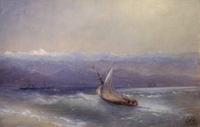
Sea on the mountains background
Ivan Aivazovsky
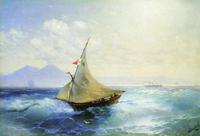
Landscape with Vesuvius
Ivan Aivazovsky
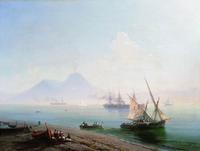
The Bay of Naples in the morning
Ivan Aivazovsky
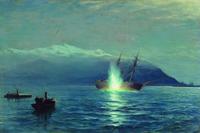
Sinking the Turkish steamer 'Intibach' by boats of ship 'Grand Duke Constantine' in the Batumi raid on the night of January 14, 1878
Lev Lagorio
Small Stable Scene with Sheep
Josef Carl Berthold Puttner
Rescue at Sea
Ivan Aivazovsky
Stormy Sea at Sunset
Ivan Aivazovsky
Watching Ships at Sunset
Ivan Aivazovsky
Near coast of Yalta
Ivan Aivazovsky
A shipwreck
Edward Moran
The capture of Turkish nave on Black sea
Ivan Aivazovsky
Steamboat in a Storm on the North Sea
Albert Rieger
Fishing Boats Going Out
David James
Before battle. Ship. Constantinople
Ivan Aivazovsky
Battle of steamship Vesta and Turkish ironclad
Ivan Aivazovsky