
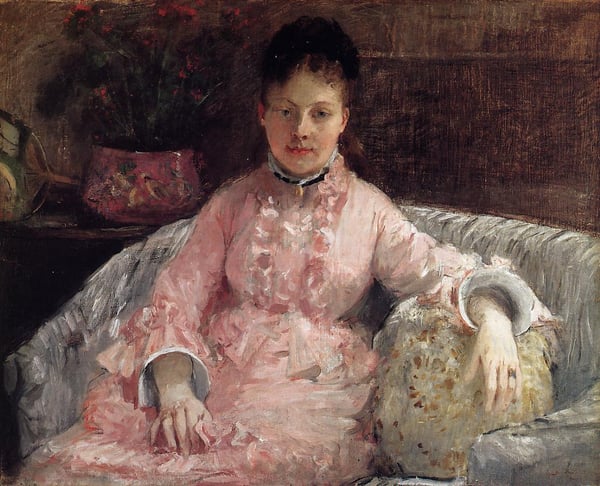
Analisi esperta di Portrait of a Woman in a pink dress di Berthe Morisot
Stile: Impressionism · Genere: portrait
Expert Analysis: Portrait of a Woman in a Pink Dress by Berthe Morisot
Berthe Morisot’s Portrait of a Woman in a Pink Dress exemplifies the radical ambitions of Impressionist portraiture while marking the artist’s distinctive contribution as a leading female figure in the movement. The work is significant for several reasons that align with the core innovations of Impressionism, particularly in its treatment of light, color, and the intimate, unposed quality of its subject.
First, Morisot’s choice of a pink dress is not merely decorative but a deliberate exercise in capturing atmospheric effects. The Impressionists rejected the local color (the “true” hue of an object) in favor of perceptual color—the way light and reflection alter a surface. Here, the pink is modulated with streaks of white, lavender, and pale blue, suggesting the shifting play of daylight across fabric. This technique, known as “broken color,” gives the dress a shimmering, almost vibrating presence, turning a static garment into a record of a specific moment and environment.
Second, the portrait’s significance lies in its departure from traditional formal portraiture. Morisot often painted women in domestic or casual settings, and this work likely continues that theme. The woman’s gaze is direct yet soft, lacking the stiff, hierarchical presentation of earlier academic portraits. Instead, Morisot captures a fleeting, psychological intimacy—a hallmark of Impressionist portraiture that prioritized the sitter’s momentary mood over enduring monumentality. The loose, feathery brushstrokes on the face and background further dissolve hard outlines, merging figure and setting into a unified optical field.
Finally, as a female Impressionist, Morisot brought a unique perspective to the genre. She had access to private, genteel spaces that her male colleagues could not penetrate, allowing her to depict women with a naturalism free from the theatricality of the male gaze. The pink dress, while fashionable, is rendered with a spontaneity that emphasizes the sitter’s individuality rather than her social role. In this way, the painting challenges conventions of both gender and artistic hierarchy, asserting that a fleeting, everyday moment is as worthy of profound visual exploration as a historical or mythological scene.
In sum, Portrait of a Woman in a Pink Dress stands as a testament to Morisot’s skill in synthesizing the core concerns of Impressionism—light, color, and modern life—while advancing a sensitive, autonomous vision of femininity that was rare in the art of her time.
Museum / Gallery
Visivamente simili
20 opere con composizione e palette affini
Young Woman on a Couch
Berthe Morisot
Young Woman
Berthe Morisot

Portrait of a Woman
Pierre-Auguste Renoir
Portrait of a seated lady
Constant Mayer
A Visitor
Sarah Purser
Indifference
Victor Gabriel Gilbert

In The Studio
William Merritt Chase
Woman in scarlet dress with newspaper sheet and ficus
Anton Romako

Lisen Lamm
Anders Zorn
Portrait of the Artist's Sister, Mme Edma Pontillon, c.1872-75
Berthe Morisot
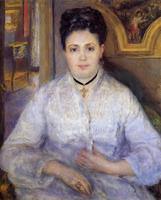
Madame Victor Chocquet
Pierre-Auguste Renoir

Mrs. Ian Hamilton (Jean Muir)
John Singer Sargent
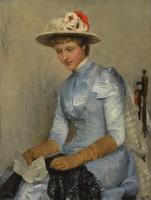
Forget Me Nots
Arthur Hacker
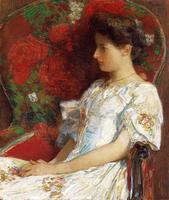
The Victorian Chair
Childe Hassam
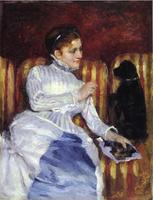
Woman on a Striped Sofa with a Dog
Mary Cassatt
Portrait of Mrs Chadwyck-healy and Her Daughter
Walter Osborne

The Lady in white
Marie Bracquemond
In the Garden
Edouard Manet
Sweet Repose
Victor Gabriel Gilbert
Reverie
Alfred Stevens