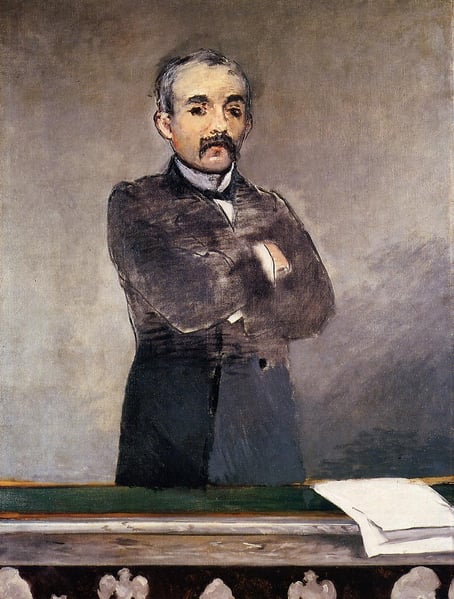
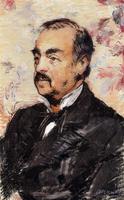
Portrait of Clemenceau at the tribune
Details
Expert analysis of Edouard Manet’s Portrait of Clemenceau at the tribune
Style: Realism · Genre: portrait
Expert Analysis: "Portrait of Clemenceau at the tribune" by Édouard Manet
This work is a quintessential example of Realist portraiture, reflecting Manet’s commitment to depicting contemporary life with unflinching directness. As a portrait of the French statesman Georges Clemenceau, it captures not a ceremonial or idealized image but a specific, moment-in-time view of a public speaker at the tribune (the platform for parliamentary oratory).
Significance within Realism and the Portrait Genre:
- Rejection of Idealization: Unlike traditional academic portraits that glorified subjects through allegorical or heroic conventions, Manet presents Clemenceau with stark authenticity—his posture, gaze, and setting grounded in the modern political arena. The artist omits superfluous decoration, focusing on the sitter’s psychological intensity and the immediacy of the speaking moment.
- Documentary Impulse: The choice of the tribune as a setting anchors the portrait in a specific social and political context, a hallmark of Realism’s interest in the quotidian and the civic. Manet elevates a transient act—a speech—to the permanence of art, emphasizing the Realist belief that contemporary, even topical, subjects were worthy of serious artistic treatment.
- Technical Restraint: Manet’s handling of paint—loose, economical strokes and a subdued palette—eschews polished finish for an effect of spontaneous observation, aligning with Realism’s avoidance of academic artifice. This approach underscores the sitter’s vitality and the candor of the encounter.
Why It Matters:
This portrait stands as a powerful intersection of art and politics in late 19th-century France. By representing Clemenceau as a speaker rather than a static icon, Manet affirms the Realist project: to record the authentic, unvarnished presence of influential figures in the midst of their public roles. It is a testament to Manet’s role in modernizing portraiture, steering it away from allegory toward a frank, documentary language that would shape subsequent modernist approaches.
Museum / Gallery
Visually similar
20 works with related composition and palette
Portrait of Georges Clemenceau
Edouard Manet
Portrait of Benedetto Marina
Umberto Veruda
Self Portrait
Ion Andreescu
Self-portrait
Felix Vallotton
Portrait of Paolo Troubetzkoy
Valentin Serov
Self-portrait
Józef Mehoffer
Portrait of Paul Alexander on green background
Amedeo Modigliani
John D. Rockefeller
John Singer Sargent
Portrait of A. I. Surikov
Vasily Surikov
André Theuriet
Jules Bastien-Lepage
Portrait of engineer Ivan Yefgrafovich Adadurov
Ilya Repin
Esposito, Composer
Sarah Purser
Portrait of the Artist Vasily Surikov
Valentin Serov
Portrait of John William Mackay
Alexandre Cabanel
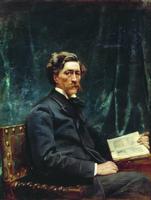
Portrait of S.Hudenkov
Konstantin Makovsky
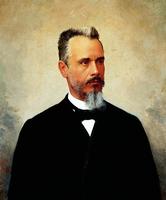
Portrait of Bernardino de Campos
Jose Ferraz de Almeida Junior
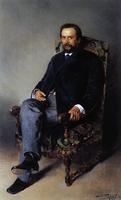
Portrait of I. E. Tsvetkov
Vladimir Makovsky
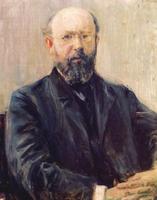
Portrait of Professor Dr. Carl Bernstein
Max Liebermann
The painter of animals
Edouard Manet
The notary
Filadelfo Simi