Expertenanalyse zu Edouard Manets Still life with melon and peaches
Stil: Realism · Genre: still life
Expert Analysis: "Still Life with Melon and Peaches" by Édouard Manet
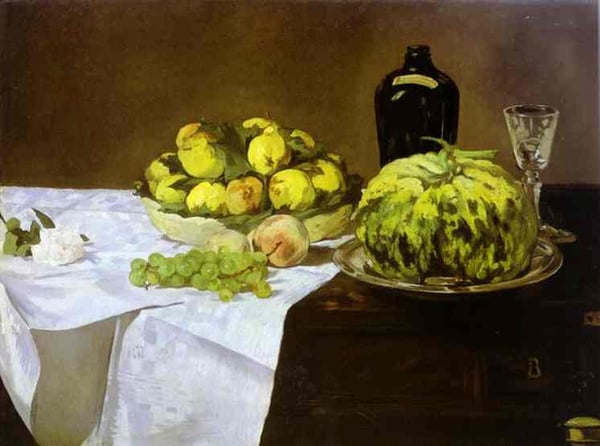
Édouard Manet’s Still Life with Melon and Peaches exemplifies the artist’s radical rethinking of a centuries-old genre within the context of Realism. Painted during a period when he was moving away from the grand historical and social subjects that had made him controversial, this work showcases Manet’s ability to elevate ordinary objects into a study of visual perception and painterly technique.
Significance in Style and Period
Manet’s still life is significant for its departure from the highly polished, illusionistic traditions of academic still-life painting. Instead of meticulously modeling each fruit to mimic texture and translucency, Manet uses broad, visible brushstrokes and simplified forms. The melon’s rind is rendered in flat, unmodulated patches of green and yellow, while the peaches appear as soft, almost abstract spheres of ochre and rose. This approach reflects the Realist commitment to depicting the world as it is seen—immediate, unidealized, and without romantic gloss.
The composition is intentionally asymmetrical: the melon is sliced open, revealing its earthy, red flesh and dark seeds, while the peaches are piled casually on a white tablecloth. Manet treats the entire surface of the canvas with equal attention, flattening the space and emphasizing the painting’s two-dimensional nature. This flattening, combined with the stark contrasts between light and shadow, anticipates the later concerns of Impressionism and even Modernist abstraction.
Art-Historical Context
At a time when still life was considered the lowest genre in the academic hierarchy, Manet’s choice to paint such a subject with the same seriousness he gave to his Olympia or Le Déjeuner sur l’herbe was a subtle but defiant statement. He underscores that a simple arrangement of fruit can carry the same weight of artistic inquiry as a history painting. The work also reveals Manet’s admiration for Spanish masters like Velázquez and the Dutch still-life tradition, but he transforms their meticulous detail into a language of speed and spontaneity.
What Makes It Remarkable
The true significance of Still Life with Melon and Peaches lies in its radical handling of paint and its relationship to the viewer’s gaze. Manet presents the fruits not as edible illusions but as physical facts of paint on canvas. The chopped melon, with its exposed interior, becomes a metaphor for the act of painting itself—laying bare the process, the raw material, and the artist’s hand. In this sense, the work is a quiet manifesto of Realism’s core belief: that art should be a truthful record of sight, not a window into an idealized world.
This painting stands as a bridge between the objective vision of Courbet’s Realism and the subjective light-play of the Impressionists. It reminds us that Manet, often called the “father of modern art,” could find profound modernity in the simplest of subjects—a melon and a few peaches—transformed by a bold, unflinching brush.
Visuell ähnlich
20 Werke mit ähnlicher Komposition und Farbpalette
Still Life
Ilya Mashkov
Reel 88
Marc Horowitz
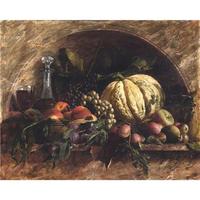
Still life in a marble niche
Pierre Jean Edmond Castan
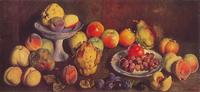
Fruits from the agricultural exhibition
Ilya Mashkov
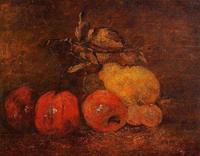
Still Life with Pears and Apples
Gustave Courbet
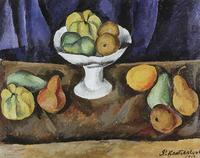
Fruit-piece
Pyotr Konchalovsky
Stillleben Mit Früchten, Und Glasware
Juan van der Hamen
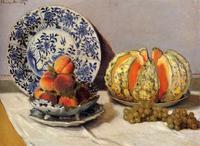
Still Life with Melon
Claude Monet
Still life with fruits
Ilya Mashkov
Still Life with Fruit
Pierre-Auguste Renoir
Still life with a basket of apples and two pumpkins
Vincent van Gogh
Still life
Judith Leyster
Apples and Manderines
Pierre-Auguste Renoir
Galimberti Sándor Gyümölcs Csendélet 1906
Galimberti Sándor
Still Life with Basket of Apples
Vincent van Gogh
Curtain, Jug and Fruit
Paul Cezanne
Fruit Basket with Apples and Grapes
Claude Monet
Still Life with Pears and Grapes
Claude Monet
Autumn landscape
Martiros Sarian
Dessert
Paul Cezanne