Curtain, Jug and Fruit
Dettagli
Analisi esperta di Curtain, Jug and Fruit di Paul Cezanne
Stile: Post-Impressionism · Genere: still life
Expert Analysis: "Curtain, Jug and Fruit" (c. 1899-1900) by Paul Cézanne
Painted during Cézanne’s final period, this still life represents a pivotal moment in the transition from Post-Impressionism to early Modernism. The work is significant for its radical departure from traditional perspective and its deliberate construction of form through color, temperature, and planar shifts.
Composition and Spatial Tension
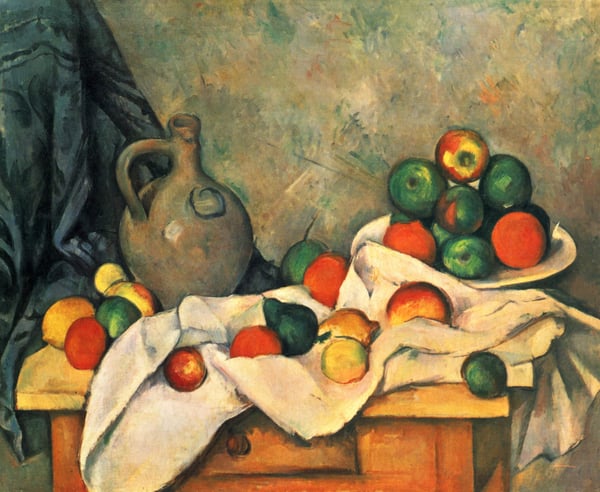
Cézanne subverts classical still-life conventions by flattening the picture plane while simultaneously creating an ambiguous, compressed depth. The curtain—draped and bunched—acts both as a backdrop and as an active sculptural element, its folds rendered as faceted planes rather than soft drapery. The jug tilts forward on the table, its oval opening slightly misaligned with its base, a deliberate distortion that forces the viewer to perceive the object from multiple viewpoints simultaneously. The fruit (apples and oranges) are built from small, hatched brushstrokes of greens, yellows, and reds, their contours often left incomplete or "bleeding" into adjacent colors.
Structural Harmonization of Color
Cézanne’s mature theory of modulation—using color to model volume instead of chiaroscuro—is fully realized here. Warm oranges and reds advance, while cool blues and greens recede, creating a rhythmic play across the canvas. The tablecloth is not simply white; it is built from overlapping patches of blue, violet, and ochre, unifying the foreground and background into a single, woven chromatic fabric. This technique emphasizes the process of seeing and constructing, rather than mere description.
Significance in Art History
This painting epitomizes Cézanne’s late style, where the tangible world is reduced to its essential geometric core—cylinders, spheres, and cones—without losing its sensuous presence. The instability of the table edge, the warped perspective, and the deliberate “inconsistencies” prefigure the analytical experiments of Cubism. Henri Matisse and Pablo Picasso both cited this very period of Cézanne’s still lifes as the foundation for their own radical departures. By sacrificing literal accuracy for a deeper structural truth, Cézanne transforms a humble arrangement of objects into a meditation on perception itself—a hallmark that makes Curtain, Jug and Fruit a cornerstone of modern painting.
Museum / Gallery
Visivamente simili
20 opere con composizione e palette affini
Still life, jug and fruit on a table
Paul Cezanne
Still Life with Water Jug
Paul Cezanne
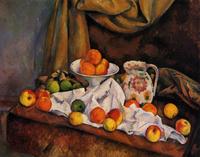
Fruit Bowl, Pitcher and Fruit
Paul Cezanne
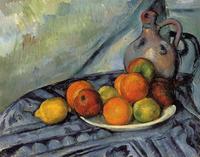
Fruit and Jug on a Table
Paul Cezanne
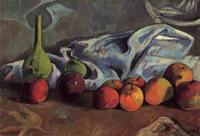
Still life with apples and green vase
Paul Gauguin
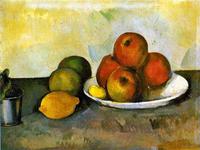
Still life with Apples
Paul Cezanne
Still Life Post, Bottle, Cup and Fruit
Paul Cezanne
Still life with fruit
Gregoire Boonzaier
Still life with fruits
Paul Cezanne
Ginger Jar
Paul Cezanne
Still life with apples and jug
Paul Serusier
Still Life. Apples
Ilya Mashkov
Apples and Oranges
Paul Cezanne
Plate of Apples
Paul Serusier
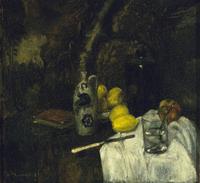
Lemons and Bottle of Dutch Gin
Henri Matisse
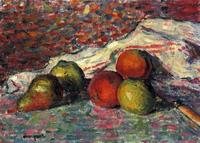
Fruit, Knife and Napkin
Albert Marquet
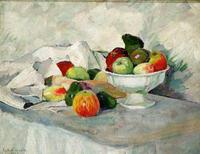
Apples and pears on white
Ilya Mashkov
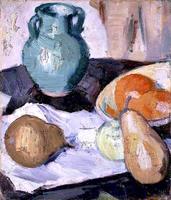
The Green Jar
Samuel Peploe
Still Life
Samuel Peploe
Still Life with Oranges
Andre Derain