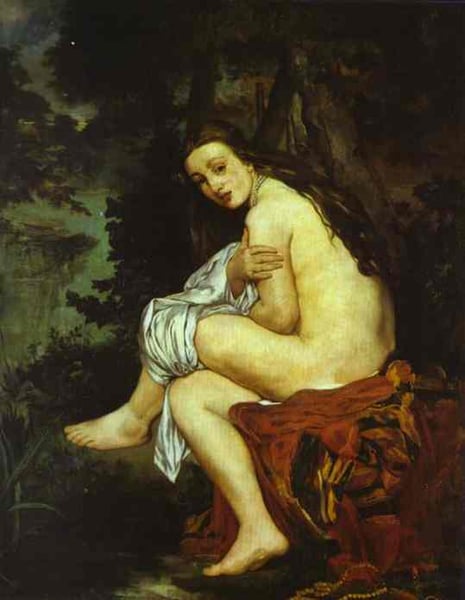
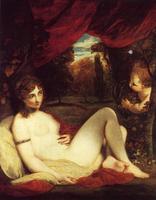
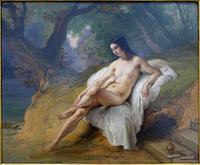
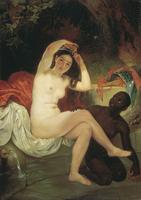
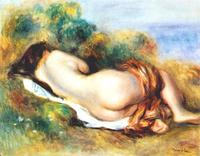
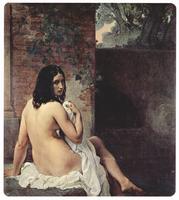
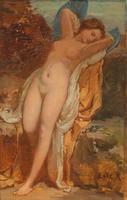
Edouard Manet’s Surprised Nymph is a striking example of how Realism reshaped mythological painting in the 19th century. While the genre traditionally demanded idealized, allegorical figures, Manet subverts this by grounding the nymph in a naturalistic, almost confrontational immediacy. The “surprise” in the title suggests a moment of interruption, drawing the viewer into a scene that feels more like a candid encounter than a staged myth. This aligns with Manet’s broader challenge to academic conventions—most famously in Olympia and Le Déjeuner sur l’herbe—where classical nudes are recast as contemporary, psychologically present figures. Here, the nymph’s pose and expression likely break with the passive, decorative tradition, emphasizing instead a raw, human vulnerability. The significance lies in Manet’s radical fusion: he uses Realist techniques—bold brushwork, flattened space, and a refusal to soften the model’s individuality—to demystify a mythological subject, forcing the viewer to see it not as an ideal but as a living, tangible moment. This work thus stands as a pivotal bridge between the waning Academic tradition and the emerging modern sensibility.