Analisi esperta di Bathsheba di Karl Bryullov
Stile: Romanticism · Genere: religious painting
Expert Art Historical Analysis: "Bathsheba" by Karl Bryullov
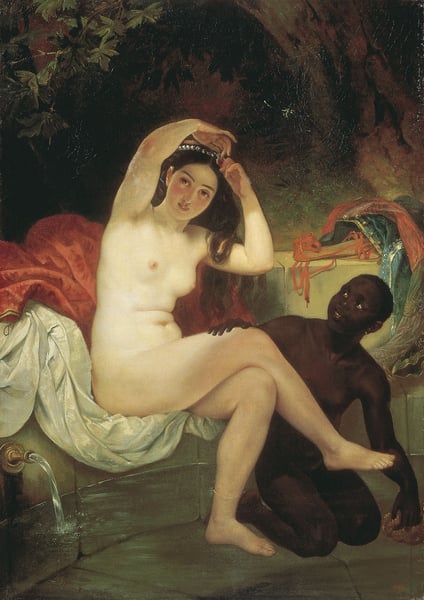
Karl Bryullov’s Bathsheba (c. 1832) stands as a masterful synthesis of Romantic emotionalism and academic precision, redefining the traditional religious painting through a lens of dramatic sensuality and psychological depth. Though the subject is drawn from the Old Testament (2 Samuel 11)—the moment King David spies on Bathsheba bathing—Bryullov shifts the focus from moral allegory to an intimate, almost voyeuristic encounter, characteristic of Romanticism’s fascination with intense human experience and the sublime.
Significance within Romanticism and Religious Painting:
-
Elevation of the Female Figure: Unlike earlier Baroque or Renaissance treatments that often cast Bathsheba as a passive victim or a symbol of temptation, Bryullov imbues her with a poignant, reflective stillness. Her nude form is rendered with luminous, creamy flesh tones that catch the light, emphasizing both her vulnerability and her quiet dignity. This aligns with Romanticism’s interest in individual emotion and the sublime beauty of the human body, yet it never descends into mere eroticism—the artist’s careful modeling and the soft, diffused lighting keep the scene reverent.
-
Dramatic Composition and Color: Bryullov employs a rich, warm palette—deep russets, ochres, and cool blues—to create a contrast between the intimate foreground (the bathing figure) and the distant, shadowy architecture where David lurks. The diagonal sweep of Bathsheba’s body and the flowing drapery create a dynamic tension that pulls the viewer’s eye toward her face, which is turned slightly away, lost in thought. This use of diagonal movement and chiaroscuro is a hallmark of Bryullov’s Romantic style, learned from his study of Italian Renaissance masters but infused with a new emotional urgency.
-
Psychological Nuance: The painting’s significance also lies in its refusal to moralize. Bryullov does not depict David directly; instead, the viewer becomes the unseen observer, forcing a confrontation with the gaze itself. The focus on Bathsheba’s inner world—her introspection, perhaps her awareness or resignation—elevates the work beyond a simple scripture illustration. It becomes a meditation on power, desire, and the human condition, typical of Romanticism’s preoccupation with subjectivity.
-
Technical Virtuosity: Bryullov’s treatment of water, fabric, and skin is exceptionally skilled. The rippling reflections in the pool, the translucent folds of the cloth, and the soft modeling of the figure all demonstrate his academic training while serving Romanticism’s goal of evoking awe. The painting’s almost palpable atmosphere of stillness and anticipation makes it a pivotal work in 19th-century Russian art, bridging the classical tradition and the Romantic movement.
In sum, Bathsheba is significant because it transforms a canonical religious episode into a psychologically charged, visually sumptuous Romantic drama. Bryullov’s ability to balance formal perfection with emotional resonance marks the work as a key example of how religious painting could be revitalized through the Romantic lens, focusing on individual experience and the awe-inspiring beauty of the natural—and human—world.
Museum / Gallery
Visivamente simili
20 opere con composizione e palette affini
Baigneuse endormie
Theodore Chasseriau
Mary Magdalene In The Cave
Jules Joseph Lefebvre
Baigneuse
William-Adolphe Bouguereau
Venus Bathing
Camille Corot
Susanna and the Elders
Pieter van Hanselaere
A Seating Bather
Pierre-Auguste Renoir
Satyr and Nymph
Konstantin Makovsky
The Toilet of Venus
William-Adolphe Bouguereau
Cimon and Iphigenia
Joshua Reynolds
After the bath
Jose Ferraz de Almeida Junior
Venus Bathing (Innocence)
Pierre-Paul Prud'hon
Venus
Joshua Reynolds
Sleeping Bacchant
Károly Lotz
Musidora
Thomas Sully
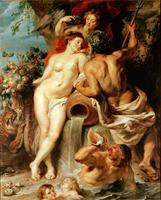
The Union of Earth and Water Antwerp and the Scheldt
Peter Paul Rubens
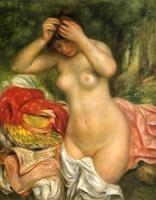
Bather Arranging her Hair
Pierre-Auguste Renoir
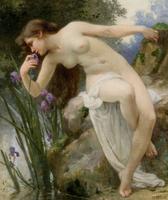
Fragrant Iris
Guillaume Seignac
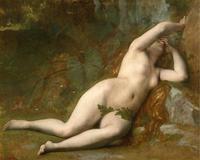
Eve After the Fall
Alexandre Cabanel
A Pastoral Idyll
Louis Léopold Robert
Venus und Adonis
Pierre-Paul Prud'hon