Expert analysis of Théodore Géricault’s Horse leaving a Stable
Style: Romanticism · Genre: animal painting
Expert Analysis: "Horse leaving a Stable" by Théodore Géricault
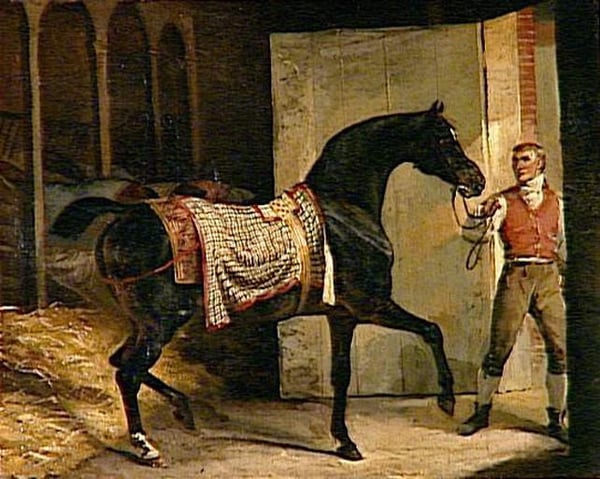
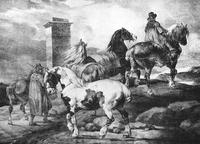
This work stands as a quintessential example of Romanticism's fascination with raw, untamed energy. Géricault, already celebrated for his monumental The Raft of the Medusa, turns his keen eye to the animal kingdom, specifically the horse—a creature that became a central motif in his oeuvre. Painted during a period when he obsessively studied equine anatomy and motion, Horse leaving a Stable captures a fleeting, explosive moment. The horse is not a placid, posed subject; rather, it bursts from the darkness of the stable into the light, nostrils flared, muscles taut, and mane wild. This is not merely a "animal painting" in the traditional sense of a static portrait; it is a dramatic narrative compressed into a single gesture.
What makes this work significant within Romanticism is its rejection of neoclassical order in favor of visceral immediacy. Géricault’s loose, almost violent brushwork and the stark chiaroscuro (the sharp contrast between the stable’s shadow and the horse’s gleaming white body) heighten the sense of panic and liberation. The animal is both a real creature—meticulously studied from life and from anatomical drawings—and a symbol of nature’s uncontrollable power. In the Romantic imagination, the horse represented freedom, instinct, and the sublime force that civilization seeks to tame. By framing the horse in the act of departure, Géricault suggests a boundary being crossed: from confinement to wildness, from darkness to light. This painting thus serves as a microcosm of Romanticism’s core ideals—emotion over reason, motion over stasis, and the sublime over the beautiful. It is a testament to Géricault’s ability to transform a simple stable scene into a charged, psychological drama.
Museum / Gallery
Visually similar
20 works with related composition and palette
Queen of Trumps in a Stable, with Two Grooms
John Frederick Herring Sr.
Gniady Koń
Henryk Rodakowski
Earl Grosvenor's Bandy
George Stubbs
Snap With Trainer
George Stubbs
Antonio
John Frederick Herring Sr.
Sketch from the Horse Fair
Rosa Bonheur
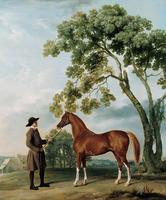
Lord Grosvenor's Arabian Stallion with a Groom
George Stubbs
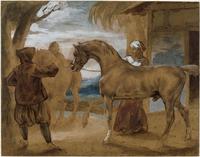
Arabian Stallion led by two Arabians to breed
Théodore Géricault
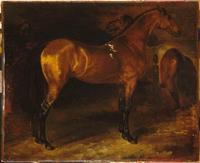
Spanish horse in a stable
Théodore Géricault
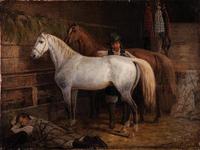
KONIE W STAJNI
January Suchodolski
postilion
Piotr Michałowski
British Racehorse Vespa with Her Owner, Sir Mark Wood
John Frederick Herring Sr.
Horses going to a fair
Théodore Géricault
A Saddled Bay Hunter
George Stubbs
Horses and Soldiers in a Stable
January Suchodolski
A Bay Hunter Named 'Sir Oliver'
John Boultbee
A Grey Horse
George Stubbs
Horse carriage
Théodore Géricault
Horses
Théodore Géricault
'Emilius', a Bay Racehorse in a Paddock
John Frederick Herring Sr.