Expert analysis of Théodore Géricault’s Horses going to a fair
Style: Romanticism · Genre: animal painting
Expert Analysis: "Horses going to a fair" by Théodore Géricault
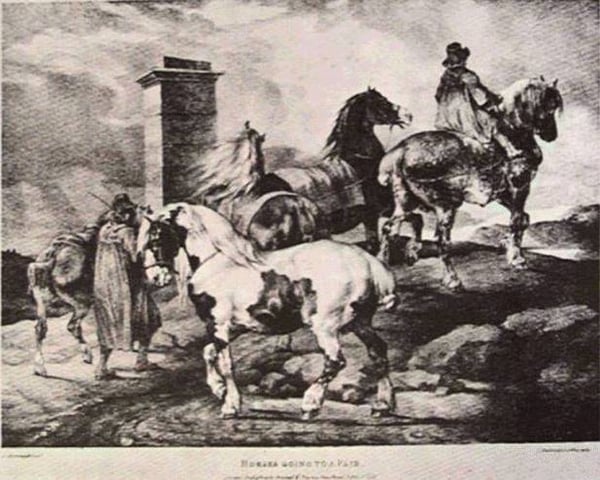
Théodore Géricault’s Horses going to a fair stands as a quintessential example of Romanticism’s break from the ordered, idealized forms of Neoclassicism. Within the genre of animal painting—often dismissed as mere decorative or sporting imagery in earlier academies—Géricault elevates the horse to a subject of profound emotional and symbolic weight.
Dynamic Composition and Movement:
The painting captures a moment of raw, uncontained energy. The horses surge forward in a powerful, diagonal thrust, their bodies twisted and straining against restraint. Géricault’s composition rejects static balance; instead, he creates a sense of imminent chaos—muscles ripple, manes fly, and hooves churn the earth. This dynamism is a hallmark of Romanticism, prioritizing visceral experience over calculated harmony.
Emotional and Sublime Intensity:
Romantic artists sought to evoke awe, fear, and the sublime—here, the horses appear less as domesticated animals and more as forces of nature. Their wide eyes, flared nostrils, and tense postures convey a primal panic or wildness. Géricault does not sentimentalize them; he shows them as powerful, almost untamable beings, reflecting the Romantic fascination with the raw, untamed aspects of existence.
Technical Mastery and Influence:
Géricault’s anatomical precision—honed through his study of cadavers and his obsessive sketching of horses at slaughterhouses—gives the animals a startling physicality. Yet he subverts academic polish with energetic, visible brushstrokes and dramatic chiaroscuro. This approach influenced later Realists and Impressionists, as well as the continued elevation of animal painting from minor genre to a vehicle for exploring passion, mortality, and human insignificance in the face of nature.
Significance in Context:
Created during a period when Géricault was increasingly drawn to themes of struggle and suffering (paralleling his masterpiece The Raft of the Medusa), Horses going to a fair can be read as a metaphor for the restless, driven spirit of the Romantic era itself. It transforms a mundane country fair into a scene of breathtaking power, reminding us that even in everyday life, nature’s sublime energy—and the artist’s ability to capture it—can erupt with timeless force.
Visually similar
20 works with related composition and palette
Horses
Théodore Géricault
Horse with rider
Giorgio de Chirico
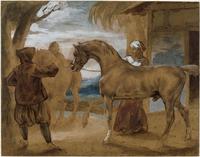
Arabian Stallion led by two Arabians to breed
Théodore Géricault
Horse Market in Algiers
Paul-Albert Besnard
Sketch from the Horse Fair
Rosa Bonheur
Horses on the run
Giorgio de Chirico
Studies by two riders
Albrecht Durer
Cheval Arabe
Carle Vernet
The Centaurs--Nessus
Gustave Dore
Horse leaving a Stable
Théodore Géricault
The Inferno, Canto 12
Gustave Dore
Horses and temple
Giorgio de Chirico
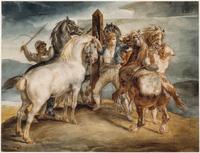
The Horse Market: Five Horses at the Stake
Théodore Géricault
Reiter Und Drache
Franz Sedlacek
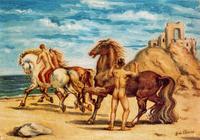
Horses with riders
Giorgio de Chirico
Equestrian monument
Leonardo da Vinci
MERKUR BIETET BATTUS EINE KUH DES ADMETOS AN
Johann Heinrich Roos
Horse carriage
Théodore Géricault
Cavalryman with a Red Hat and a Blue Cloak
Giorgio de Chirico
Runaway horse with stableboy and pavilion
Giorgio de Chirico