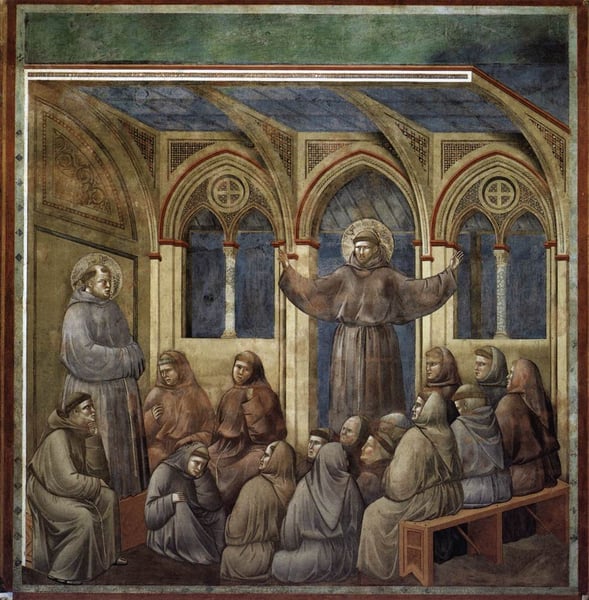
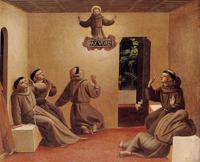
Expert Analysis of "The Apparition at the Chapter House at Arles" by Giotto
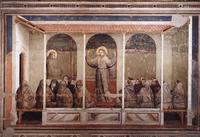
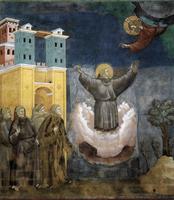
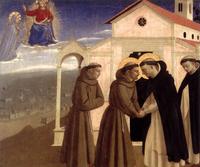
Within the Proto-Renaissance style, Giotto’s religious painting marks a decisive break from the flat, hieratic compositions of the Byzantine and Gothic traditions. This work is significant for its pioneering use of naturalism to convey a sacred narrative with emotional immediacy and physical believability.
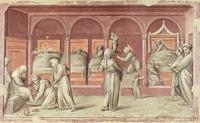
Giotto achieves this through several key innovations characteristic of the Proto-Renaissance: he models figures with chiaroscuro (light and shadow) to give them volumetric weight, arranges them in a shallow but coherent architectural space, and orchestrates their gestures and gazes to create a clear, dramatic focal point—the apparition itself. The scene is no longer a static symbol but a human-scale event, inviting the viewer into a moment of spiritual revelation grounded in observable reality.
As a religious painting, it serves not merely as an icon for veneration but as a narrative tool that makes the divine accessible through human emotion. Giotto’s ability to compress a miraculous appearance into a convincing, everyday setting—the chapter house—was revolutionary. This work exemplifies the Proto-Renaissance shift toward observation-based representation, laying the groundwork for the full Renaissance exploration of perspective, anatomy, and psychological depth. Its significance lies in its role as a bridge: it retains the spiritual gravity of medieval art while introducing the naturalistic principles that would define Western painting for centuries.