Expert analysis of Hiroshige’s Two Mandarin Ducks
Style: Ukiyo-e · Genre: bird-and-flower painting
Expert Analysis: "Two Mandarin Ducks" by Hiroshige (Utagawa Hiroshige)
Style: Ukiyo-e | Genre: Bird-and-flower painting (kachō-ga)
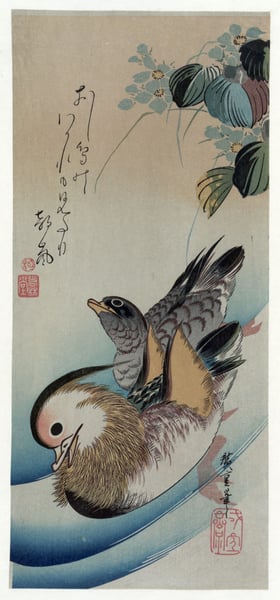
Hiroshige’s "Two Mandarin Ducks" stands as a masterful example of kachō-ga (bird-and-flower pictures) within the Ukiyo-e tradition—a genre traditionally dominated by the Edo-period Kanō and Rinpa schools. While Hiroshige is best known for his landscape series like The Fifty-three Stations of the Tōkaidō, this work reveals his equal virtuosity in intimate natural studies, bridging the lyrical elegance of classical Japanese painting with the popular, accessible medium of the woodblock print.
Stylistic and Technical Significance
The composition is deceptively simple: a pair of mandarin ducks (symbols of marital fidelity and conjugal bliss in East Asian art) nestle among water reeds and blossoming branches. Hiroshige’s handling of line is both delicate and decisive—the ducks’ plumage is rendered with refined, flowing contours that echo the tradition of yamato-e, while the subtle gradation of colors (characteristic of Ukiyo-e printing) gives the scene a soft, atmospheric depth. The restrained palette—muted greens, warm ochres, and the striking orange of the male duck’s feathers—demonstrates his mastery of bokashi (color gradation), a technique he pioneered in landscapes and here adapts to enhance the naturalistic sheen of feathers and water.
Cultural and Symbolic Context
In Edo-period Japan, kachō-ga served as a poetic meditation on nature’s transient beauty, often imbued with seasonal or moral symbolism. Mandarin ducks were a favored motif not only for their visual appeal but for their Confucian associations with devoted partnership. Hiroshige’s rendering avoids sentimentality; the ducks are observed with the same documentary precision he applied to mountain passes and rain-swept bridges, yet their intimate posture—heads turned toward one another—infuses the scene with quiet narrative. This synthesis of naturalism and symbolic nuance was central to Ukiyo-e’s appeal among urban merchants and samurai, who sought both decorative pleasure and moral resonance.
Significance within Ukiyo-e and Hiroshige’s Oeuvre
"Two Mandarin Ducks" represents a key intersection of Ukiyo-e’s evolution: by mid-19th century, the genre had expanded beyond kabuki actors and courtesans to embrace landscapes and nature studies, elevating prints from mere ephemera to refined art objects. Hiroshige’s kachō-ga prints were particularly influential—they synthesized the Japanese Rinpa love of stylized pattern with the Western-influenced perspective and atmospheric effects he had absorbed from Dutch engravings. This work thus exemplifies the global dialogue embedded in late Ukiyo-e, anticipating the Japonisme that would soon captivate European Impressionists.
In sum, "Two Mandarin Ducks" is significant not only for its technical grace and emotional restraint but for how it crystallizes Hiroshige’s unique ability to elevate a conventional subject to a serene, resonant meditation on nature and human connection—a feat that cemented his legacy as one of Ukiyo-e’s most versatile and influential masters.
Museum / Gallery
Visually similar
20 works with related composition and palette
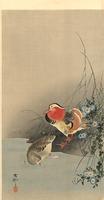
Mandarin Ducks
Ohara Koson
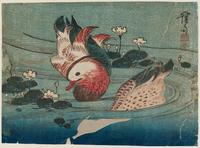
Two Ducks
Keisai Eisen
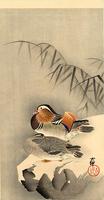
Mandarin Ducks in Snow
Ohara Koson
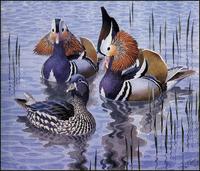
Mandarin Ducks
Charles Tunnicliffe
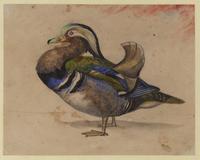
A Mandarin drake
Eugene Delacroix
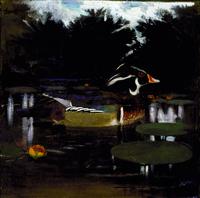
Male Wood Duck in a Forest Pool
Abbott Handerson Thayer
Quiet Couple
Kaoru Kawano
Quiet Couple (Oshidori)
Kaoru Kawano
Two Crows in a Tree
Shen Zhou
Lotus and Ducks
Ding Yanyong
Lotus, Frogs and Mandarin Ducks
Ding Yanyong
Duck's head
Nicholas Roerich
Select-o-Mat Tempest I
Peter Phillips
Mandarin Ducks
Ding Yanyong
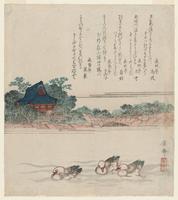
Komagata-dô Temple at Onmaya Embankment (Onmaya-gashi)
Keisai Eisen
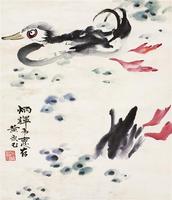
Duck
Huang Yongyu
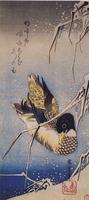
Reeds in the Snow with a Wild Duck
Hiroshige
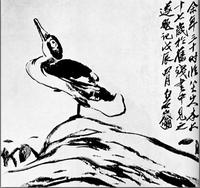
Duck
Qi Baishi
Ducks
Se-Ok Suh
Buffel Headed Duck American Green Winged Teal And Hooded Merganser
Archibald Thorburn