
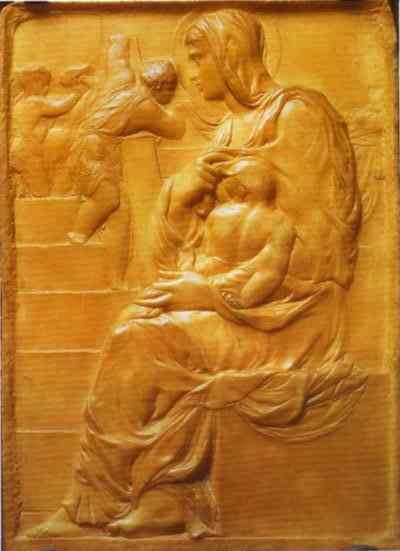
Expertenanalyse zu Michelangelos Madonna of the Stairs
Stil: High Renaissance · Genre: sculpture
Expert Analysis: Madonna of the Stairs by Michelangelo
As one of Michelangelo’s earliest surviving sculptures, Madonna of the Stairs (c. 1490–1492) is a remarkable testament to the artist’s precocious mastery within the High Renaissance style. Carved in shallow relief (rilievo schiacciato), the work captures the Virgin Mary and the Christ Child in a tender, intimate moment, yet it already exhibits the monumental gravity and psychological depth that would define Michelangelo’s later oeuvre.
Significance within the High Renaissance
The High Renaissance is characterized by a harmonious balance between idealized naturalism, classical poise, and profound human emotion. In this relief, Michelangelo transcends the decorative quality typical of earlier religious sculpture by infusing the scene with a quiet, introspective monumentality. The Madonna’s pose—turning slightly away while cradling the Child—creates a dynamic, contrapposto-like torsion that lends the marble a sense of latent energy. Her downward gaze and the child’s alert posture suggest a narrative of foreknowledge and protection, themes Michelangelo would later develop in works like the Pietà.
Technical and Stylistic Innovation
Michelangelo employs low relief to achieve an illusion of depth that rivals painting, a technique learned from Donatello but refined with a sculptural vigor unique to the High Renaissance. The subtle gradations of shadow across the Virgin’s drapery and the delicate modeling of the infant’s limbs demonstrate an early confidence in rendering human anatomy and texture. The inclusion of a staircase (the “stairs” of the title) is not merely a background element; it functions as a compositional anchor, guiding the eye upward and symbolizing the spiritual ascent toward salvation—a motif that resonates with the era’s fusion of classical form and Christian allegory.
In its intimate scale and sculptural subtlety, Madonna of the Stairs marks the dawn of Michelangelo’s lifelong exploration of the tension between divine grace and human fragility, making it a foundational work of the High Renaissance.
Museum / Gallery
Visuell ähnlich
20 Werke mit ähnlicher Komposition und Farbpalette
Madonna Col Bambino
Desiderio da Settignano
Madonna Col Bambino
Desiderio da Settignano
Vierge À L'enfant
Desiderio da Settignano
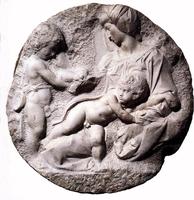
Madonna and Child with the Infant Baptist
Michelangelo
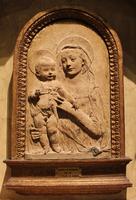
Madonna Col Bambino
Desiderio da Settignano
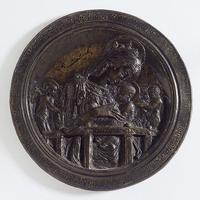
Virgin and Child with Four Angels
Donatello
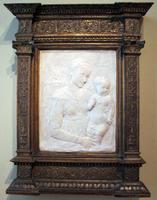
Madonna Col Bambino
Desiderio da Settignano
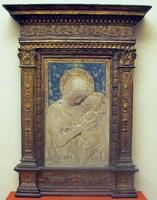
Madonna Col Bambino
Desiderio da Settignano
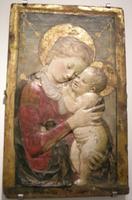
Madonna Col Bambino
Desiderio da Settignano
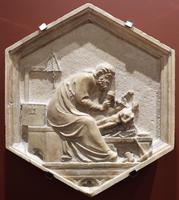
1333 6 Andrea Pisano Phidias Campanile
Andrea Pisano
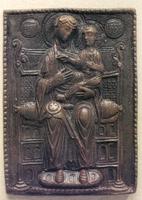
Virgin Mary on the Throne
Orthodox Icons
Monument to Lady Leicester. Angel carrying infant and leading mother to heaven
John Gibson
Firenze
Giambologna
Création d'Eve
Andrea Pisano
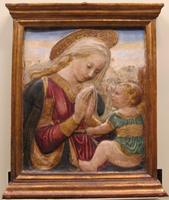
Madonna Col Bambino
Desiderio da Settignano
Po Bitki
Joseph Urbania
Madonna with Child
Filippo Brunelleschi
Adoration of the Magi
John Flaxman
The Meeting of Hero and Leander
John Gibson
The Holy Virgin Blachernitissa (early copy of 'Theotokos of Blachernae')
Orthodox Icons