
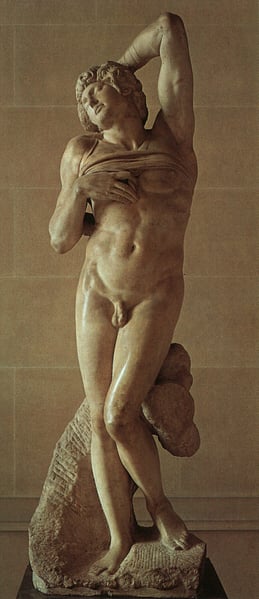
Expert analysis of Michelangelo’s The Dying Slave
Style: High Renaissance · Genre: sculpture
As an expert art historian, I will analyze "The Dying Slave" by Michelangelo based solely on the provided facts: it is a sculpture belonging to the High Renaissance style. Here is my expert description, focusing on its significance within that style and period.
Expert Analysis: "The Dying Slave" by Michelangelo
Michelangelo’s The Dying Slave is a masterwork of High Renaissance sculpture, and its significance lies in how it epitomizes the period’s revolutionary approach to human form, emotion, and unfinished expression. Created for the never-completed tomb of Pope Julius II, this marble figure is one of a series of “slaves” or “prisoners” that Michelangelo carved with varying degrees of finish. The Dying Slave, in particular, is a striking embodiment of the High Renaissance ideals of idealized naturalism, psychological depth, and terribilità—the artist’s awe-inspiring, almost violent creative power.
Form and Composition: The figure is a nude male, captured in a sinuous, contrapposto-like twist. One arm is raised behind his head, while the other rests limply at his side. His chest is slightly expanded, and his head tilts back, eyes closed, mouth slightly open. This pose—reminiscent of a languid, ecstatic swoon—blends classical grace with a palpable sense of physical and spiritual release. The marble is carved with meticulous anatomical precision: the ribcage, abdominal muscles, and sinews are rendered in exquisite detail, yet the surface is deliberately left rough in places (the “non-finito” technique), creating a tension between the polished body and the raw, unfinished stone.
Expressive Content: The title “Dying” implies a final moment, but Michelangelo transcends mere death. The figure seems to be in a state between struggle and surrender—a profound inner experience that the High Renaissance prized. It is not a violent death, but a quiet, almost sensual passing, perhaps allegorizing the soul’s liberation from the body, or the human condition itself. This psychological complexity—the ability to convey a specific, intense emotion through a single, carefully balanced pose—is a hallmark of High Renaissance sculpture.
Significance within High Renaissance Style:
- Humanism and Idealization: Michelangelo fuses a profoundly human, vulnerable presence with an idealized, heroic physique. The slave’s body is perfect yet mortal; his expression is individualized yet universal. This balance between naturalism and idealism defines the High Renaissance.
- Non-Finito: The partially unfinished surface is not a defect but a deliberate aesthetic choice, later celebrated as a signature of Michelangelo’s genius. It invites the viewer to witness the sculptor’s process—the emergence of form from the block—and to contemplate the spiritual tension between matter and soul. This “unfinished” quality became a powerful, innovative statement about artistic process and the limits of human creation.
- Spatial and Compositional Mastery: The serpentine twist of the torso creates a dynamic, spiraling rhythm that engages the viewer from every angle. This figura serpentinata was a defining feature of High Renaissance and later Mannerist sculpture, and Michelangelo perfected it here, making the marble seem to breathe and shift within its static medium.
In the context of the High Renaissance, The Dying Slave stands as a poignant testament to Michelangelo’s ability to invest stone with the full range of human emotion—from agony to ecstasy, from struggle to release. It is not merely a captive figure, but a profound meditation on life, death, and the power of art to transcend the unfinished, the incomplete, and the ineffable.
Museum / Gallery
Visually similar
20 works with related composition and palette
The Rebellious Slave
Michelangelo
Bacchus
Michelangelo
Apollo
Michelangelo
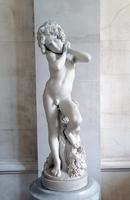
Young Bacchus
Giovanni Duprè
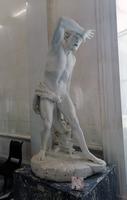
Cain
Giovanni Duprè
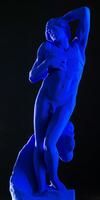
Dying
Yves Klein
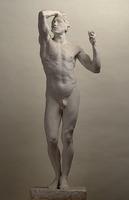
Age of Bronze
Auguste Rodin
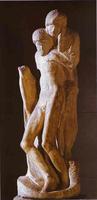
Pieta Rondanini (unfinished)
Michelangelo
Mimesi
Giulio Paolini
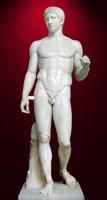
Doryphoros, by Polykleitos (Roman copy)
Ancient Greek Painting and Sculpture
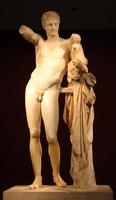
Hermes with Young Dionysus, by Praxyteles
Ancient Greek Painting and Sculpture
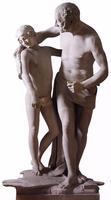
Daedalus and Icarus
Antonio Canova
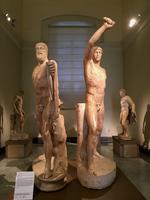
The Tyrannicides, by Antenor
Ancient Greek Painting and Sculpture
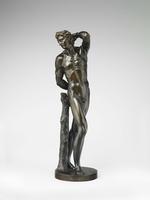
San Sebastiano
Alessandro Vittoria
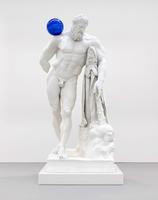
Gazing Ball (Farnese Hercules)
Jeff Koons
Narcissus
John Gibson
Young Man
Arno Breker
Apollo
Giovanni Battista Piranesi
The Sluggard
Frederic Leighton
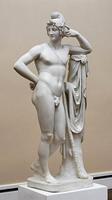
Paris
Antonio Canova