Expertenanalyse zu Antonio Canovas Paris
Stil: Neoclassicism · Genre: sculpture
This analysis focuses on the significance of Antonio Canova’s Paris within the context of Neoclassical sculpture.
Artwork: Paris
Artist: Antonio Canova
Style: Neoclassicism
Genre: Sculpture
Expert Analysis
As a quintessential Neoclassical sculpture, Canova’s Paris embodies the movement’s core ideals: a return to the serene grandeur, idealized forms, and moral clarity of Greco-Roman antiquity. The work’s significance lies in its perfect synthesis of classical myth and sculptural perfection, reflecting Neoclassicism’s reverence for reason, harmony, and timeless beauty.
Iconic Subject and Idealization
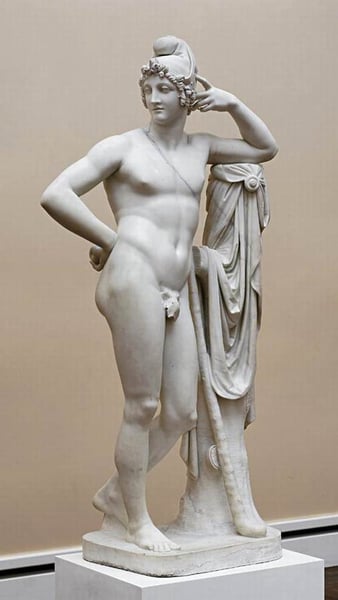
The sculpture portrays Paris, the Trojan prince who judged the golden apple among the goddesses, a pivotal story from classical mythology. Canova elevates this figure beyond a simple narrative depiction. Instead, Paris is shown as an idealized, godlike youth—his features calmly noble, his body perfectly proportioned and free from flaws. This idealization is a hallmark of Neoclassicism, which sought to capture the “universal” and “eternal” essence of humanity rather than individual, transient reality.
Composition and Posture
True to Neoclassical principles, the sculpture avoids dramatic movement or overwrought emotion. Paris stands in a graceful contrapposto—one leg bearing weight, the other relaxed—creating a subtle S-curve that recalls ancient Greek kouroi and Roman marble copies of Hellenistic works. His head is turned slightly, his gaze distant and contemplative, suggesting the moment of judgment without overt theatricality. This restrained, balanced composition emphasizes clarity, order, and intellectual calm, directly opposing the dynamism and emotional excess of the Baroque and Rococo styles that preceded Neoclassicism.
Canova’s Technical Mastery
Within the genre of sculpture, Canova demonstrates extraordinary skill in rendering marble with a lifelike, almost ethereal softness—a signature of his practice. The smooth, polished surface of Paris’s skin contrasts with the delicate textures of his hair and the subtle folds of his cloak, showcasing the Neoclassical pursuit of il bello ideale (ideal beauty) through flawless craftsmanship. The sculptor’s ability to make cold stone appear warm and breathing is a reminder of the ancient Greek maxim that art should improve upon nature.
Significance within Neoclassicism
Paris stands as a testament to Neoclassicism’s central goals: moral instruction through classical themes, a longing for lost antiquity, and a belief in art’s power to elevate the viewer beyond the mundane. Canova’s sculpture does not tell a dramatic story; it invites contemplation. The figure’s youthful beauty and poised introspection mirror the Enlightenment values of reason and virtue that Neoclassicism championed. In the context of the late 18th and early 19th centuries, when Europe looked to ancient Rome and Greece for models of civic virtue and aesthetic perfection, Paris was more than a decorative object—it was an embodiment of intellectual and artistic ideals. Canova’s work influenced generations of sculptors and reinforced the primacy of marble as the medium for high art, solidifying his role as the leading Neoclassical sculptor of his era.
Visuell ähnlich
20 Werke mit ähnlicher Komposition und Farbpalette
Gazing Ball (Farnese Hercules)
Jeff Koons
Hermes with Young Dionysus, by Praxyteles
Ancient Greek Painting and Sculpture
Aphrodite of Knidos (Praxiteles)
Ancient Greek Painting and Sculpture
Perseus with the Head of Medusa
Antonio Canova
The Tyrannicides, by Antenor
Ancient Greek Painting and Sculpture
Farnese Hercules, by Glykon
Ancient Greek Painting and Sculpture
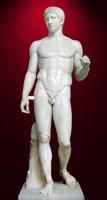
Doryphoros, by Polykleitos (Roman copy)
Ancient Greek Painting and Sculpture
Mimesi
Giulio Paolini
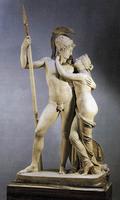
Venus and Mars
Antonio Canova
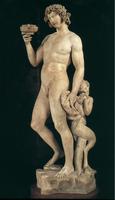
Bacchus
Michelangelo
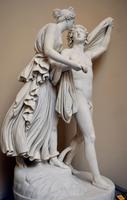
Cephalus and Aurora
John Flaxman
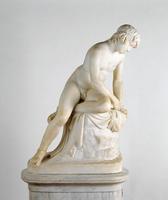
Narcissus
John Gibson
Apollo
Giovanni Battista Piranesi
Apollo
Michelangelo
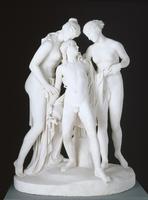
Hylas Surprised by the Naiades
John Gibson
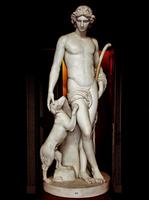
Pastoral Apollo
John Flaxman
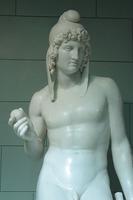
Paris
John Gibson
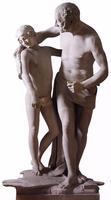
Daedalus and Icarus
Antonio Canova
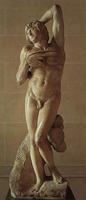
The Dying Slave
Michelangelo
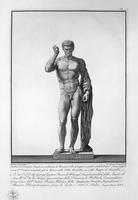
Germanicus in the guise of Mercury
Giovanni Battista Piranesi