Analisi esperta di Madame Eugène Viollet le Duc di Jean Auguste Dominique Ingres
Stile: Neoclassicism · Genere: portrait
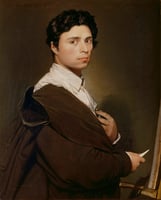
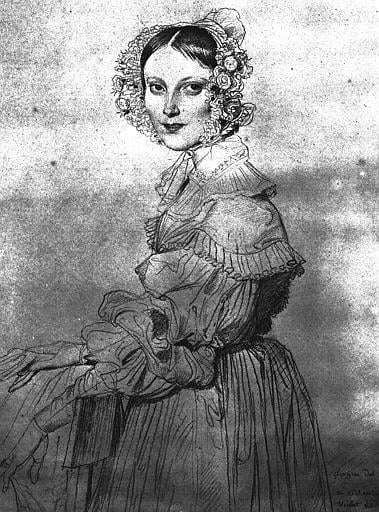
This portrait of Madame Eugène Viollet le Duc by Jean Auguste Dominique Ingres is a masterful embodiment of Neoclassical portraiture, revealing the artist’s profound commitment to line, form, and refined elegance. Painted during the height of Ingres’ career, the work stands as a significant example of how Neoclassicism could transcend mere imitation of antique models to create a timeless, psychologically resonant image.
Composition and Technique
Ingres, a supreme draftsman, structures the portrait with rigorous clarity. The sitter is presented in three-quarter view, her gaze directly engaging the viewer, while her figure is set against a neutral, dark background that emphasizes her silhouette. The smooth, almost invisible brushwork—hallmark of Ingres’ finish—creates a surface that is both polished and warm. Every detail, from the delicate folds of her gown to the precise curls of her hair, is rendered with a linear precision that subordinates color to contour, a key Neoclassical principle.
Significance within Neoclassicism
What makes this portrait particularly significant is its synthesis of idealization and individuality. Ingres adheres to Neoclassical tenets of harmony, balance, and restraint, yet he infuses the sitter with a palpable sense of inner life. Her expression is composed but not cold; her posture is formal yet subtly relaxed. This duality reflects Ingres’ unique position as both a guardian of classical tradition (his teacher Jacques-Louis David’s legacy) and a precursor to the psychological depth later explored by the Romantics.
Context and Legacy
The sitter, Madame Viollet le Duc, was the wife of the renowned architect and restorer Eugène Viollet-le-Duc, a figure better known for his Gothic Revival work. Ingres’ portrait of her thus captures a moment of cultural intersection: the Neoclassical artist immortalizing the matriarch of a family that would champion medieval architecture. The painting remains a testament to Ingres’ ability to elevate portraiture to a study of character and grace, securing his reputation as the undisputed master of the Neoclassical portrait.
Museum / Gallery
Visivamente simili
20 opere con composizione e palette affini
Mademoiselle Cecile Panckoucke
Jean Auguste Dominique Ingres
Madame Jean Auguste Dominique Ingres, born Madeleine Chapelle
Jean Auguste Dominique Ingres
Madame Jean Auguste Dominique Ingres, born Delphine Ramel
Jean Auguste Dominique Ingres
Madame Charles Gounod, born Anna Zimmermann
Jean Auguste Dominique Ingres
Madame Louis-Francois Bertin
Jean Auguste Dominique Ingres
Madame Charles Simart, born Amélie Baltard
Jean Auguste Dominique Ingres
Madame Louis François Godinot, born Victoire Pauline Thiolliere de L'Isle
Jean Auguste Dominique Ingres
Madame Franz Adolf von Stuerler, born Matilda Jarman
Jean Auguste Dominique Ingres
Madame Felix Gallois, born Nathalie Rose Joachime Bochet
Jean Auguste Dominique Ingres
Madame Jean Auguste Dominique Ingres, born Madeleine Chapelle III
Jean Auguste Dominique Ingres
Portrait of miss Bonnard
Jean Auguste Dominique Ingres
Lady William Henry Cavendish Bentinck, born Lady Mary Acheson I
Jean Auguste Dominique Ingres
A Young Woman with a Basket
Rembrandt
Madame Jean Auguste Dominique Ingres, born Madeleine Chapelle II
Jean Auguste Dominique Ingres
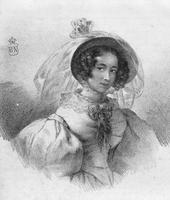
Self Portrait
Rosario Weiss Zorrilla
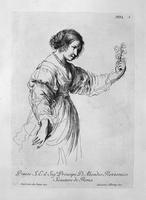
Half figure of a woman holding out a flower
Giovanni Battista Piranesi
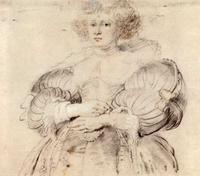
Portrait of Helena Fourment
Peter Paul Rubens
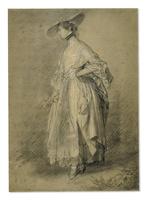
A woman with a rose
Thomas Gainsborough
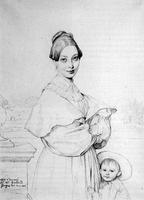
Madame Baltard and her daughter, Paule
Jean Auguste Dominique Ingres
Portrait Of A Lady, Possibly Julia Jackson
George Frederick Watts