
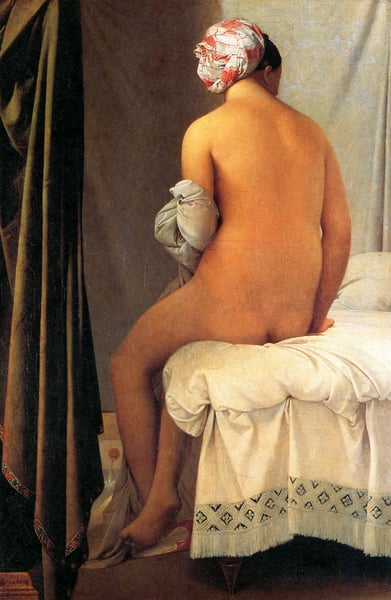
Expert analysis of Jean Auguste Dominique Ingres’s The Bather of Valpinçon
Style: Neoclassicism, Orientalism · Genre: nude painting (nu)
Expert Analysis: "The Bather of Valpinçon" (1808) by Jean-Auguste-Dominique Ingres
As a masterwork of Neoclassicism tinged with burgeoning Orientalist fascination, Ingres’s The Bather of Valpinçon (also known as The Seated Bather or La Baigneuse Valpinçon) occupies a pivotal place in the history of the nude. Painted when Ingres was still a student in Rome, the work exemplifies the artist’s lifelong obsession with idealized line, sculptural form, and exotic sensuality.
Composition and Style The painting presents a solitary female figure seen from behind, seated on the edge of a bed, her torso turned in a subtle contrapposto that reveals a graceful curve of the spine and the soft shadow of her lower back. This back‑view pose—unusual for its time—allowed Ingres to concentrate on the pure, flowing contour of the body, demonstrating his Neoclassical allegiance to line as the chief vehicle of beauty. The flesh is rendered with a cool, ivory smoothness, almost porcelain-like, with minimal modeling; the skin seems to glow against the deep blue drapery and the dark, ambiguous background. Ingres deliberately suppressed anatomical detail to achieve an idealized, abstracted form—a hallmark of his mature style.
Orientalist Elements Despite its Neoclassical restraint, the work introduces exotic motifs that would later define Ingres’s Orientalist phase. The sumptuous turban, the patterned shawl draped across the bed, the hookah-like water pipe (often called a nargileh), and the glimpse of a marble bath beyond—all point to a fantasy of the Ottoman harem. This fusion of classical simplicity with Eastern decadence was groundbreaking: Ingres took the academic tradition of the nude and infused it with a discreet, almost voyeuristic sensuality. The bather is not a mythological goddess or a historical model but an anonymous, private figure, inviting the viewer into an intimate, exotic interior.
Significance in Art History
-
Revolutionary Use of the Back View – Before Ingres, the female nude was almost always shown frontally or in three‑quarter profile. By choosing the back, he emphasized contour and silhouette over facial expression or narrative, making the body itself the sole subject. This approach directly influenced later artists such as Degas, Renoir, and even Picasso, who explored similar reclining and bather figures.
-
Precursor to Ingres’s “Turkish Bath” – The Bather of Valpinçon is the direct ancestor of Ingres’s later, more overtly Orientalist masterpiece, The Turkish Bath (1862). In that work, the same back‑view bather reappears as a central figure, now surrounded by a crowd of nude women in a round composition. The earlier painting thus stands as the seed of a lifelong artistic motif.
-
Tension between Neoclassicism and Romanticism – While rooted in the Neoclassical tradition of David (Ingres’s teacher), the painting’s languid, dreamy mood and its exotic accoutrements anticipate the Romantic fascination with the East. This dual character made Ingres a controversial figure in his own time—admired for his draftsmanship yet criticized for his “Gothic” deformations of anatomy.
-
Influence on Modernist Abstraction – The smooth, simplified surfaces and the emphasis on pure line over realistic representation prefigure aspects of modernism. Later artists, particularly Matisse and the Nabis, looked to Ingres’s decorative flatness and his ability to reduce form to its essential rhythms.
In summary, The Bather of Valpinçon is significant not only as a masterful example of Ingres’s technical brilliance but also as a bridge between the academic ideal and an emerging Orientalist fantasy, and as a touchstone for later explorations of the nude in Western art. Its quiet, contemplative sensuality continues to captivate viewers and scholars alike, securing its place as one of the great icons of 19th‑century painting.
Museum / Gallery
Visually similar
20 works with related composition and palette
The Small Bather
Jean Auguste Dominique Ingres
The Grande Odalisque
Jean Auguste Dominique Ingres
Sapho (Young girl in a Pompeian interior)
Charles Gleyre
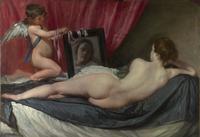
The Rokeby Venus
Diego Velazquez
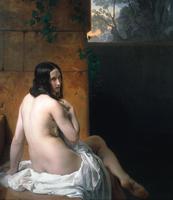
Susanna at her Bath
Francesco Hayez
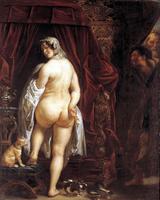
King Candaules of Lydia Showing his Wife to Gyges
Jacob Jordaens
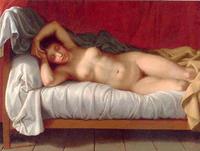
Lying Model in Bed
Christoffer Wilhelm Eckersberg
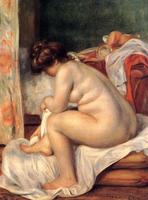
Woman After Bathing
Pierre-Auguste Renoir
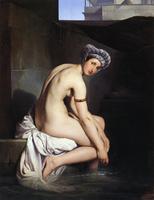
Bathsheba
Francesco Hayez
Reclining nude
Emmanuel Benner
Bare Shoulders
Domenico Induno
The Toilette
Antoine Watteau
Odalisque
Francois Boucher
Ballerina Carlotta Chabert as Venus
Francesco Hayez
The Final Session
Jean-Leon Gerome
Odalisque
Jules Joseph Lefebvre
Nude
Polychronis Lembesis
Woman Standing in Front of a Mirror or Morning Toilette
Christoffer Wilhelm Eckersberg
Judith
Andrei Belloli
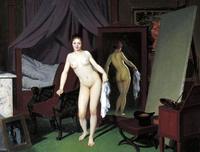
Model in the Studio
Christoffer Wilhelm Eckersberg