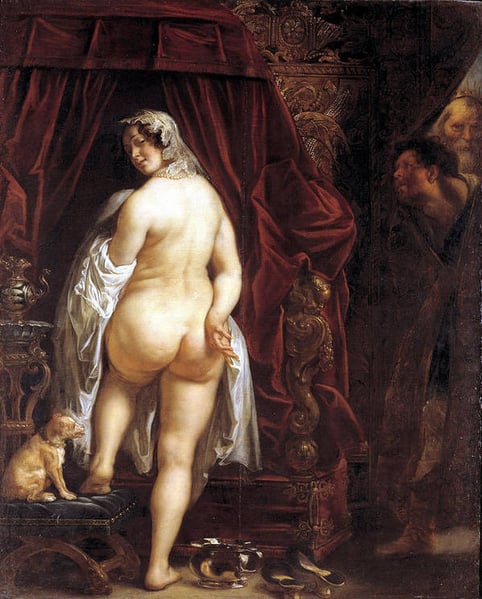
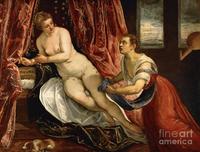
As a Baroque literary painting, Jacob Jordaens' "King Candaules of Lydia Showing his Wife to Gyges" is significant for its vivid embodiment of the period's fascination with dramatic, morally charged narratives drawn from classical and historical sources. The work captures a pivotal, tension-filled moment from the ancient story—where King Candaules, in a act of hubris and voyeuristic pride, compels his bodyguard Gyges to witness the queen's nudity—and translates it into the quintessentially Baroque language of psychological intensity and visual spectacle.
Within the Baroque style, Jordaens excels at using strong chiaroscuro, rich, saturated colors, and dynamic, compressed compositions to heighten the scene's inherent drama. The significance lies not merely in the recounting of the myth, but in how Jordaens frames the moral ambiguity and impending tragedy: the king's oblivious arrogance, the queen's violated dignity, and Gyges' uncomfortable complicity. This aligns perfectly with Baroque art's broader preoccupation with the extremes of human emotion—power, shame, desire, and betrayal—often rendered in stark, theatrical terms. Moreover, as a Flemish Baroque master, Jordaens infuses the work with a robust, earthy physicality, making the moment of exposure feel palpably intimate and dangerous. In this way, the painting stands as a key example of how Baroque literary painting transformed ancient texts into immediate, visceral experiences for its viewers.