Francisco Goya sanatçısının The Greasy Pole eseri hakkında uzman analizi
Tarz: Romanticism · Tür: genre painting
Expert Analysis of "The Greasy Pole" by Francisco Goya
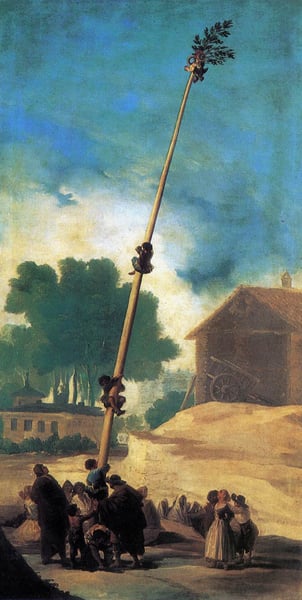
Francisco Goya’s The Greasy Pole (ca. 1786–1787) is a seminal work within the Romantic movement, demonstrating how the artist transformed a seemingly humble genre scene into a powerful commentary on human struggle and societal folly. Painted during his tenure as a court painter, the work captures a traditional Spanish festival where peasants attempt to climb a tall, greased pole to claim a prize. Goya infuses this folkloric subject with a raw, almost grotesque energy that foreshadows the darker, more critical tone of his late masterpieces.
Significance within Romanticism and Genre Painting
-
Rejection of Neoclassical Idealization – Unlike the polished, heroic scenes favored by earlier Neoclassicism, Goya presents a chaotic, unvarnished view of commoners. The straining bodies, exaggerated postures, and expressions of desperation or mockery align with Romanticism’s embrace of the imperfect, the spontaneous, and the emotionally charged.
-
The Sublime in the Mundane – Romantic artists often sought the sublime in nature or dramatic history; Goya finds it in a village game. The greased pole becomes a metaphor for the futility of ambition, the cruelty of chance, and the absurdity of social climbing—themes that resonate with Romanticism’s fascination with human limitation and the irrational.
-
Mastery of Light and Dark – Goya uses light to heighten drama: the bright sky contrasts with the deep shadows under the pole, isolating figures and emphasizing their straining forms. This chiaroscuro technique, reminiscent of his later Black Paintings, creates a tense, theatrical atmosphere that elevates a simple genre scene to a philosophical allegory.
-
Social Critique and Empathy – While depicting a peasant entertainment, Goya subtly critiques the rigid class structures of Spain. The men clawing at the pole represent the masses’ fruitless struggle for advancement, while the indifferent spectators (some well-dressed) suggest a society that watches and laughs. This blend of observation and irony is a hallmark of Goya’s genre paintings, making them far more than mere records of daily life.
In sum, The Greasy Pole is significant because it encapsulates the Romantic shift toward raw human experience, social consciousness, and psychological depth—all within the accessible guise of a genre painting. Goya’s ability to invest a folk custom with universal meaning places this work among the most insightful commentaries of its time.
Museum / Gallery
Görsel olarak benzer
İlişkili kompozisyon ve renk paletine sahip 20 eser
Twilight Landscape
Adriaen Brouwer
On the Outskirts of a Town
David Teniers the Younger
Veduta costiera con soldati
Jakob de Heusch
Peasants Dancing outside an Inn
David Teniers the Younger
Hay Makers
George Stubbs
Landscape with Deer Hunters
Salomon van Ruysdael
A Game of Bowls
Peter Angellis
River landscape with figure staffage
Jacques d'Arthois
Peasants Merry-Making
David Teniers the Younger
Dorpsgezicht
Salomon van Ruysdael
Village Celebration
Pieter Brueghel the Younger
Landscape with Figures
Jan van Goyen
The Sunset
Giorgione
The Swing
Francisco Goya
Sea Coast at Scheveningen
Simon de Vlieger
Before the Inn
David Teniers the Younger
Shrimp Boys at Cromer, Norfolk
William Collins
Astraias Abschied Von Den Hirten
Salvator Rosa
Landscape with Cottages on the Dunes
Jan van Goyen
Figures with Cattle in a Landscape
Thomas Gainsborough