Witches' Sabbath / The Great He-Goat
Dettagli
Description
Stile: Romanticism · Genere: mythological painting
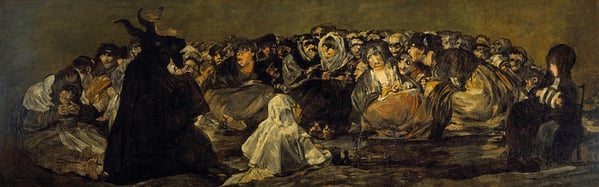
In his later years, Goya lived as a solitary and deaf recluse, disillusioned with society. He resided in his house, known as La Quinta del Sordo, located outside Madrid, where he completed his fourteen Black Paintings. Goya applied these paintings directly onto the plaster walls of his house, and despite their intensely personal nature, he did not provide any titles or write about them in his letters. These works are widely considered by art historians to reflect his deteriorating physical and mental health, as they express his deepest fears and darkest depression in a nightmarish and troubling form.
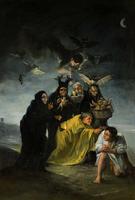
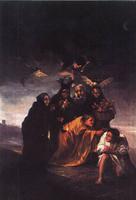
One of these paintings, known as Witches' Sabbath or The Great He-Goat, depicts a dark silhouette of the devil in the form of a goat, preaching to a group of women who are likely witches. Goya's use of rough and clumsy brushwork enhances the picture's raw and abject quality, with a cluster of ghastly characters huddled together. The use of theatrical contrasts of light and dark serves to highlight the repulsive faces of the women. Unfortunately, a large portion of the painting was lost in the transfer from plaster to canvas, leaving its full meaning and content shrouded in mystery.
Witches' Sabbath is widely believed to be a critique of the Inquisition's oppressive practices and persecution, which intensified after the Bourbon monarchy's restoration in 1814 and the accession of Ferdinand VII, an anti-Enlightenment king. Goya was a staunch supporter of Enlightenment principles, which prioritized reason over religious and cult superstitions, and he abhorred the Inquisition's politically motivated actions.
Museum / Gallery
Visivamente simili
20 opere con composizione e palette affini
The Pilgrimage of San Isidro
Francisco Goya
As You Like It
Adolphe Joseph Thomas Monticelli
Pilgrimage to the Fountain of San Isidro / The Holy Office
Francisco Goya
The Offering
Adolphe Joseph Thomas Monticelli
Witches' Sabbath
Francisco Goya
The Circumcision
Rembrandt
Blessing Children
Ilya Repin
The Raising of Lazarus
Carel Fabritius
Incantation
Francisco Goya
Young People Laughing
Francisco Goya
The Covenanters' Preaching
George Harvey
Christ Before Pilate
Frank Mason
The Fear (Homage to Francisco Goya)
Corneliu Baba
Gathering of Elegant Women
Adolphe Joseph Thomas Monticelli
Sketch for 'The Vote'
Francesco Paolo Michetti
A Wagon of the Third Class
Honore Daumier
Salon
J.M.W. Turner
Young Woman with a Letter
Francisco Goya
Joseph tells his dreams to his parents and brothers
Rembrandt
The Three Marys
Henry Ossawa Tanner