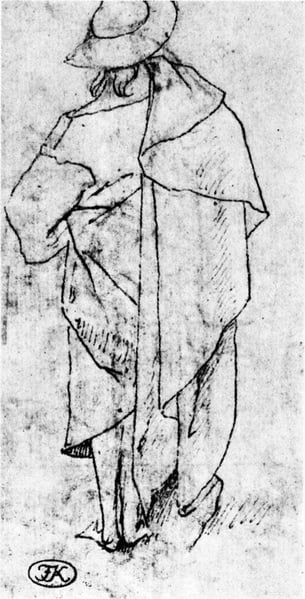
Sketch of a man
Expertenanalyse zu Hieronymus Boschs Sketch of a man
Stil: Northern Renaissance · Genre: sketch and study
Expert Analysis: Sketch of a Man by Hieronymus Bosch
Hieronymus Bosch is best known for his fantastical, morality-driven triptychs—crowded with hybrid creatures, grotesque punishments, and dreamlike landscapes—that have made him one of the most enigmatic figures of the Northern Renaissance. Against that extraordinary backdrop, Sketch of a Man (a study and sketch in genre) offers a rare, grounded glimpse into the artist’s working method and his engagement with the foundational skill of his era: direct observation of the human form.
Significance within the Northern Renaissance
-
Evidence of Bosch’s Draftsmanship
The Northern Renaissance placed a premium on painstaking detail and naturalistic rendering, often achieved through meticulous underdrawings and preparatory studies. Surviving works on paper from early Netherlandish artists are scarce, and Bosch’s are exceptionally rare. This sketch provides a direct record of his hand—his line quality, his handling of shadow through hatching, and his approach to capturing proportion and gesture. It demonstrates that even a visionary like Bosch trained in the essential academic discipline of figure drawing. -
Counterpoint to His Fantastical Imagery
Bosch’s painted oeuvre is populated by distorted, hybrid beings that deliberately defy nature. A straightforward study of a man underscores that Bosch was fully capable of conventional naturalism. This suggests his later exaggerations were not the result of ineptitude but of deliberate choice—a means to heighten moral allegory and psychological unease. The sketch thus anchors his fantastical works in a solid understanding of reality. -
Insight into Workshop Practice
In the Northern Renaissance, workshops relied on pattern books and figure studies for reuse in larger compositions. While this sketch may be a life study or a preliminary idea, it could also have served as a stock pose for a saint, a bystander, or a figure of humanity in one of Bosch’s crowded panels. Its existence hints at the practical, iterative process behind his highly original final works. -
Humanity as Moral Center
The subject—simply “a man”—is emblematic of Bosch’s persistent theme: the folly and frailty of humankind. Even in a quiet sketch, one can detect the artist’s interest in character and expression, traits that in his larger works would be exaggerated to illustrate vice or virtue. This study is thus a seed of the moral commentary that defines his entire career.
In summary, Sketch of a Man is significant not for spectacle but for its rarity and its role as a Rosetta Stone for understanding Bosch’s method. It humanizes the master of the monstrous, revealing the disciplined artist behind the visionary imagination, and affirms the centrality of observational drawing in the Northern Renaissance tradition.
Visuell ähnlich
20 Werke mit ähnlicher Komposition und Farbpalette
Study of Drapery
Andrea del Sarto
Saint John the Evangelist
El Greco
Study of Two Women
Domenico Ghirlandaio
Widebrim
Rembrandt
Apostle
Albrecht Durer
Man draped standing
Jean Auguste Dominique Ingres
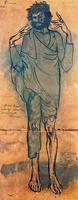
The fool
Pablo Picasso
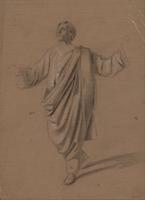
Academic study of a male figure
Marià Fortuny
John
Albrecht Durer
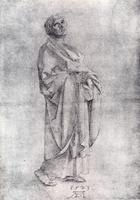
St. John Lamenting
Albrecht Durer
Four studies of a draped female figure
George Frederick Watts
St. Paul
Albrecht Durer
Study of Two Female Figures
Albert Joseph Moore
Back View of a Woman with Child Looking over Her Shoulder
John Flaxman
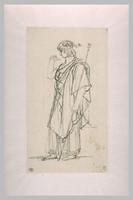
The figure of Orestes, standing draped
Pierre-Narcisse Guerin
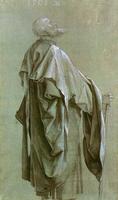
Standing Apostle
Albrecht Durer
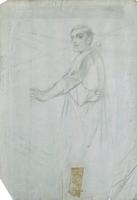
Etude Pour "Les Pèlerins D’emmaüs"
Paul Leroy
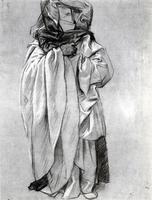
Study of Ezekiel for Frieze of the Prophets
John Singer Sargent
Saint Agnes
Adam Elsheimer
Bearded Man Stepping Down
Jacob Jordaens