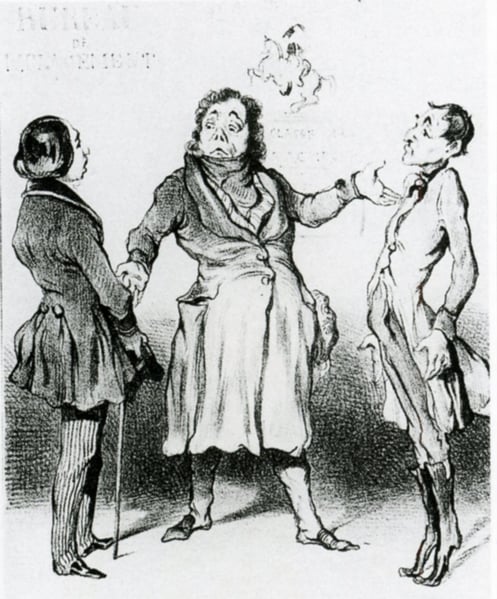
Analisi esperta di Robert Macaire Bureau of Military Replacements di Honore Daumier
Stile: Realism · Genere: caricature
As an expert art historian, I can provide the following analysis of Honoré Daumier’s Robert Macaire Bureau of Military Replacements, focusing on its significance within the context of Realism and the genre of caricature.
Significance within Realism and Caricature
Honoré Daumier’s Robert Macaire Bureau of Military Replacements stands as a landmark work at the intersection of Realism and social satire. While Daumier is often categorized under Realism for his unflinching depiction of contemporary life, his primary weapon was the caricature, which he elevated from simple comic entertainment to a sharp instrument of political and social critique. This particular print is significant for its masterful fusion of these two approaches.
1. Exposing Systemic Corruption through Realist Caricature
The work is part of Daumier’s famous series featuring the fictional swindler Robert Macaire, a character who embodied the unscrupulous, profit-driven bourgeoisie of the July Monarchy. In Bureau of Military Replacements, Daumier attacks a deeply controversial practice of the time: the system that allowed wealthy men to pay a substitute to take their place in military conscription. This effectively turned military service into a commodity, burdening the poor while sparing the rich.
Daumier’s genius lies in making this abstract injustice visually concrete. He employs the realist principle of depicting a recognizable, everyday scene—a cramped, shabby office—but populates it with grotesquely exaggerated figures. Macaire, the con man, is shown as a slick, self-satisfied operator, his face a mask of oily charm. His clients, the wealthy young men seeking to avoid service, are depicted with the physical markers of privilege: soft, idle hands and smug expressions. In contrast, the poor substitutes—likely the ragged figures in the background or the desperate man in the foreground—are rendered with the visual vocabulary of Realism: gaunt, weary, and anonymous. This juxtaposition makes the social divide not just a statistic but a visceral experience.
2. A Pioneering Blend of Genres
What makes this work profoundly significant is Daumier’s innovation in using exaggerated, almost theatrical caricature to achieve a deeper Realist truth. Unlike the detached, objective eye of other Realists like Gustave Courbet, Daumier’s line is intentionally distorted. Yet this distortion serves a purer Realism: it reveals the moral ugliness hidden beneath the polite surface of society. The caricature is not a departure from realism but its most potent form—a lens that magnifies the hypocrisy and cruelty of the period.
3. Context and Legacy
Created in a time of rapid urbanization and political upheaval, Daumier’s prints were published in mass-circulation journals, making art a tool for public debate. Robert Macaire Bureau of Military Replacements is a direct challenge to the ruling class, using the accessible language of caricature to reach a broad audience. In doing so, Daumier redefined the role of the artist: not as a mere chronicler of beauty, but as a moral witness and social critic.
In summary, this artwork is significant for its brilliant fusion of Realist observation and caricature’s bite. It transforms a specific social abuse into a timeless indictment of institutionalized inequality, proving that caricature, in the hands of a master, can be the most penetrating form of Realism.
Visivamente simili
20 opere con composizione e palette affini
To Aï Bonenfant Rendezvous
Nicolas Toussaint Charlet
Pergolesi
Pier Leone Ghezzi
Poet Composing a Classical Eclogue on the Quiet Country Life
Honore Daumier
Tenants and owners
Honore Daumier
Meo Patacca receives money from the gentlemen for the the parties he wants to do (Plate ??/52)
Bartolomeo Pinelli
The crowd crowds around the emperor in the gardens of the Elysee
Nicolas Toussaint Charlet
Illustration for Baron von Münchhausen
Gustave Dore
Portrait of French actor Étienne Mélingue (1807-1875)
Paul Gavarni
America in Distress
Paul Revere
Joyful Song Performed by M. Cobden
Honore Daumier
The Great Republican Reform Party Calling on their Candidate
Currier and Ives
Francisco António De Almeida
Pier Leone Ghezzi
Even so he cannot make her out
Francisco Goya
Mr. Fezziwig’s Ball
John Leech
Illustration to "A Week of Kindness"
Max Ernst
The brave boy of the Waxhaws
Currier and Ives
Scrooge and Bob Cratchit
John Leech
Odilon Barrot
Honore Daumier
Winter in the park
Eduardo Zamacois
Theobald Lacrosse
Honore Daumier