Экспертный разбор работы «Illustration to "A Week of Kindness"» художника Max Ernst
Стиль: Surrealism · Жанр: illustration
Expert Analysis of "Illustration to 'A Week of Kindness'" by Max Ernst
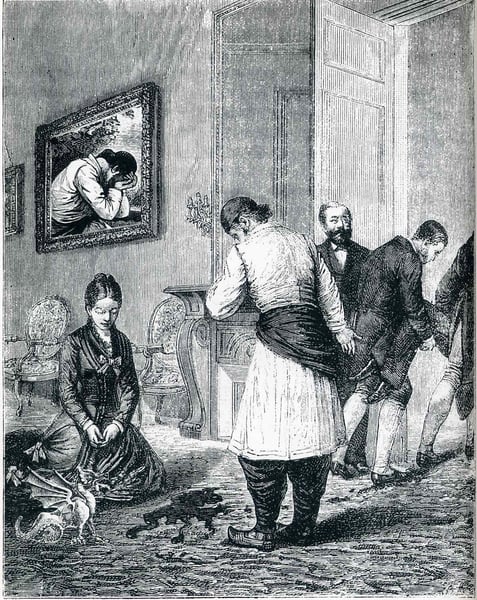
This work belongs to Max Ernst’s celebrated 1934 collage novel A Week of Kindness (French: Une semaine de bonté), created during his First French period (1922–1940). As a Surrealist illustration, it exemplifies the movement’s core ambition: to liberate the subconscious through unexpected juxtapositions and to challenge conventional narrative logic.
Significance within Surrealism:
Ernst pioneered the collage novel, using cut‑and‑pasted Victorian engravings to generate hallucinatory, dreamlike scenes that defy rational interpretation. This particular illustration demonstrates his mastery of surrealist automatism in a visual medium—each composition emerges from chance encounters of disparate elements, evoking the uncanny. The work is significant for how it weaponizes the mundane (popular printed imagery) to produce psychologically charged, often erotic or violent, symbolism.
Significance within the First French Period:
During this period, Ernst was fully immersed in the Parisian Surrealist circle, collaborating with André Breton and others. A Week of Kindness stands as the culmination of his early collage experiments, representing the movement’s high‑water mark of verbal-visual hybridity. The series abandons linear storytelling for a fragmented, oneiric sequence, mirroring Surrealist writings of the time that sought to bypass conscious control. This illustration, like the book as a whole, is a key example of how Surrealism used mass‑produced images to deconstruct reality, anticipating later developments in postmodern pastiche and appropriation.
What makes it significant:
As a genre‑defining illustration that is itself a standalone artwork, it bridges fine art and popular print culture. The work’s unsettling beauty—its stark black‑and‑white contrasts, meticulous collage technique, and subversion of Victorian morality—remains a touchstone for Surrealist visual poetry. It demonstrates Ernst’s belief that “the most beautiful images are those that lie on the borderline between sleep and waking,” cementing his role as one of the movement’s most inventive visualists.
Museum / Gallery
Визуально похожие
20 работ с близкой композицией и палитрой
Illustration to "A Week of Kindness"
Max Ernst
Illustration to "A Week of Kindness"
Max Ernst
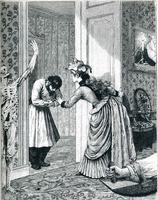
Illustration to "A Week of Kindness"
Max Ernst
The arrival of a governess in a merchant's house
Vasily Perov
Story Le Rubis Du Grand-lama
Edouard Riou
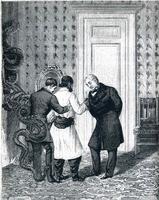
Illustration to "A Week of Kindness"
Max Ernst
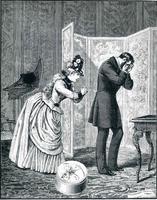
Illustration to "A Week of Kindness"
Max Ernst
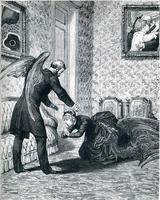
Illustration to "A Week of Kindness"
Max Ernst
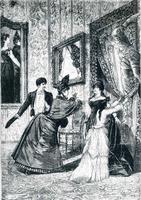
Illustration to "A Week of Kindness"
Max Ernst
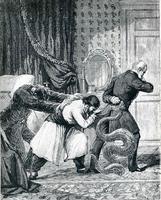
Illustration to "A Week of Kindness"
Max Ernst
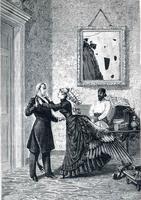
Illustration to "A Week of Kindness"
Max Ernst
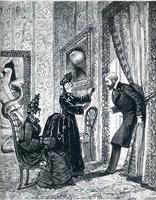
Illustration to "A Week of Kindness"
Max Ernst
Even so he cannot make her out
Francisco Goya
The Imprudence of the Second Youth, Plate 51
Daniel Chodowiecki
TOUT VIENT À QUI SAIT ATTENDRE
John Leech
The Night of the Return
John Leech
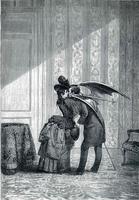
Illustration to "A Week of Kindness"
Max Ernst
Anna Karenina meets her son
Mikhail Vrubel
CHRISTMAS EVE
John Leech
Burglary at Easter Eve
Vasily Perov