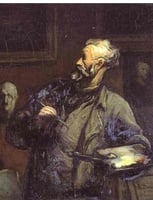
The Butcher
Expert analysis of Honore Daumier’s The Butcher
Style: Realism · Genre: genre painting
This analysis is based solely on the provided facts: artwork "The Butcher," artist Honoré Daumier, style Realism, genre genre painting.
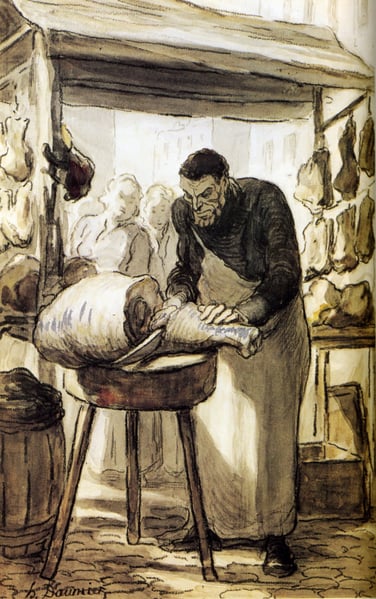
Honoré Daumier’s "The Butcher" stands as a quintessential example of Realism’s radical commitment to depicting the unvarnished reality of everyday working life. Painted during a period when the Parisian art establishment favored historical, mythological, or idealized subjects, Daumier turned his incisive eye toward the laboring class, elevating a routine market scene into a powerful statement of human dignity and social observation.
Significance within Realism:
- Rejection of Idealization: Unlike Romantic or Neoclassical depictions of laborers (often sanitized or heroic), Daumier portrays the butcher with raw, unpolished authenticity. The figure is not posed as a classical athlete but as a man of the streets, his body shaped by heavy, repetitive work. This directness aligns with Realist doctrine as articulated by figures like Gustave Courbet, who demanded that art represent “real and existing things.”
- Emphasis on Toil and Materiality: The butcher’s physicality—likely rendered with Daumier’s characteristically thick, rapid brushwork—conveys the sheer weight of his trade. The bloody carcass of meat, a detail shocking to bourgeois sensibilities in the 19th century, is presented without sentimentality, forcing viewers to confront the visceral realities behind their dinner tables. This is a hallmark of Realist genre painting: finding profound meaning in mundane labor.
Daumier’s Unique Contribution:
- Caricature and Compassion: While Daumier was celebrated as a satirical caricaturist in his lithographs for papers like Le Charivari, his paintings often temper that sharpness with empathy. In The Butcher, the figure’s sturdy stance and direct gaze communicate not ridicule but a quiet pride. The loose, almost sculptural handling of paint (influenced by his experience as a lithographer) gives the scene a sense of immediacy and movement, as if caught mid-action.
- Social Documentary: Under the July Monarchy and Second Empire, Daumier documented the lives of the urban poor and working class—ragpickers, laundresses, street performers, and butchers. This painting serves as a visual record of a disappearing pre-industrial Paris, where individual craftsmen still performed their tasks in public view. It is at once a historical document and a timeless meditation on the dignity of labor.
Stylistic Legacy:
- The Butcher foreshadows the gritty naturalism of later artists such as Gustave Caillebotte and even the Expressionists. Daumier’s ability to distill essential character through vigorous brushstrokes and stark lighting influenced generations of modernists who sought to capture the “truth” of modern life. His subject matter remains radical: a butcher, stripped of allegory or moralizing, stands as a hero of the everyday.
In sum, Daumier’s The Butcher is significant because it embodies Realism’s core mission: to see the world without artifice. Through its unflinching depiction of a working man and its masterful, sympathetic technique, the painting challenges the viewer to find beauty and meaning in the most humble of human endeavors. It is a testament to Daumier’s belief that the life of a butcher, when seen with honest eyes, is as worthy of art as the life of a king.
Visually similar
20 works with related composition and palette
The Butcher`s Shop
Annibale Carracci
Butcher in his shop
Abraham van Strij
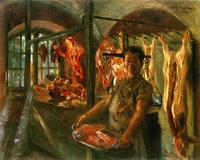
Butcher Shop
Lovis Corinth
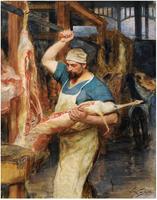
The butcher
Victor Gabriel Gilbert
Ukrainian
Henryk Rodakowski
A stonemason
Jean-Francois Millet
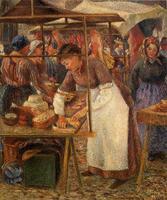
The Pork Butcher
Camille Pissarro
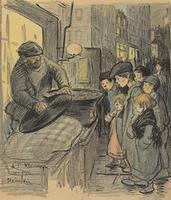
Marchand de Marrons
Theophile Steinlen
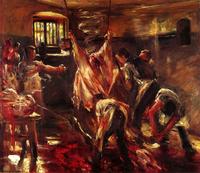
In the Slaughter House
Lovis Corinth
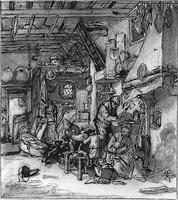
The Family
Adriaen van Ostade
Pike Street Market
Mark Tobey
The Madeleine market
Victor Gabriel Gilbert
Les Tanneurs
Maximilien Luce
The Corner Butcher
Ralph Fasanella
The Grinder
Alexandre-Gabriel Decamps
Illustration for The Ural Tales
Vyacheslav Nazaruk
La Rue & Alsace
Julien Le Blant
La Bagnole
Theophile Steinlen
Novgorod. The Fish Market.
Pyotr Konchalovsky
The Family
Adriaen van Ostade