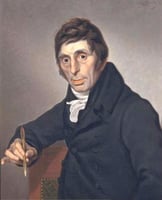
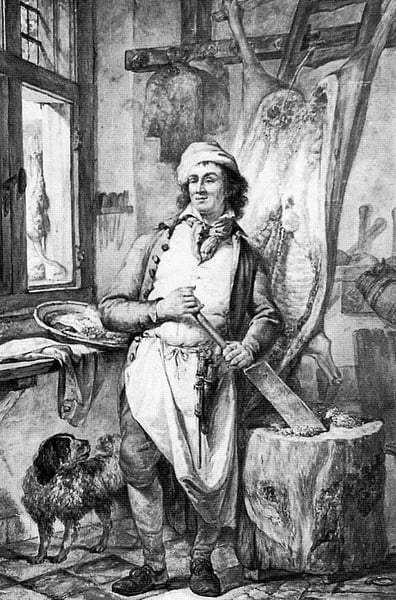
Butcher in his shop
Expert analysis of Abraham van Strij’s Butcher in his shop
Style: Neoclassicism · Genre: portrait
Expert Analysis: "Butcher in his shop" by Abraham van Strij
This work stands as a fascinating, even paradoxical, example of Neoclassical portraiture. While the predominant subjects of Neoclassicism were drawn from mythology, history, or the ruling elite, van Strij’s portrait of a butcher represents a distinctive intersection between the high seriousness of the style and the emerging interest in everyday life. The significance here lies in the elevation of a humble tradesman to the dignity and moral clarity associated with Neoclassical ideals.
In this portrait, the butcher is not depicted with crude realism but with a restrained, idealized clarity. The composition likely emphasizes solid, sculptural forms and a balanced, stable arrangement typical of Neoclassicism—placing a common worker within a timeless, ordered world. The portrait form, traditionally reserved for nobility, is here used to bestow a sense of civic virtue and honest labor upon the subject. This reflects the Enlightenment undercurrent within Neoclassicism, where reason, morality, and the value of productive work were celebrated.
What makes this painting significant is how it adapts Neoclassical principles to a genre scene, bridging the gap between the grand historical narrative and the quotidian. By applying the style’s crisp outlines, sober palette, and idealized stillness to a butcher in his professional environment, van Strij asserts that even the most ordinary vocation possesses a classical dignity. It is a portrait of a man, but also a portrait of an idea: the ethical weight of labor in a rational society.
Visually similar
20 works with related composition and palette
The Butcher`s Shop
Annibale Carracci
Two Peasants in a Kitchen Interior with a Pig's Carcass Hanging Nearby
Jan Miense Molenaer
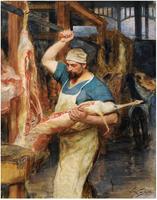
The butcher
Victor Gabriel Gilbert
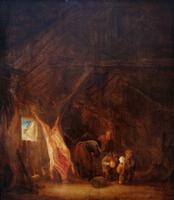
A Barn Interior with a Slaughtered Pig, Children Playing Beyond
Isaac van Ostade
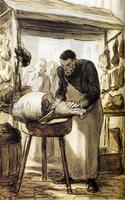
The Butcher
Honore Daumier
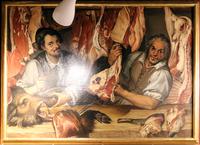
A Butchery
Bartolomeo Passerotti
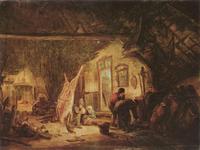
Cutting Pork Carcass
Isaac van Ostade
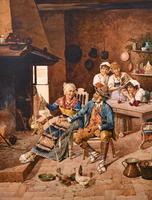
A Kitchen Interior with a Couple by the Fireside, with three Young Girls pouring Wine into a Carafe
Filippo Indoni
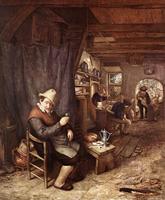
Drinking Peasant in an Inn
Adriaen van Ostade
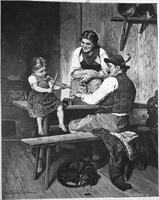
With the music
Adolf Eberle
The figurine maker (2nd version)
Gerolamo Induno
Fish salesman at woman and chidren
Abraham van Strij
The Fishwife
Adriaen van Ostade
Die Gartenlaube (the Garden Arbor)
Berthold Woltze
Ukrainian
Henryk Rodakowski
Grandfather and grandchildren
Ludwig Knaus
The Fishwife
Adriaen van Ostade
Per Degn ("Per, the deacon") sings for a glass of akvavit, An incident from the Ludvig Holberg comedy, Erasmus Montanus (Act 1, scene 4)
Wilhelm Marstrand
In the carpenter's workshop
Felix Schlesinger
Fat Kitchen
Jan Steen