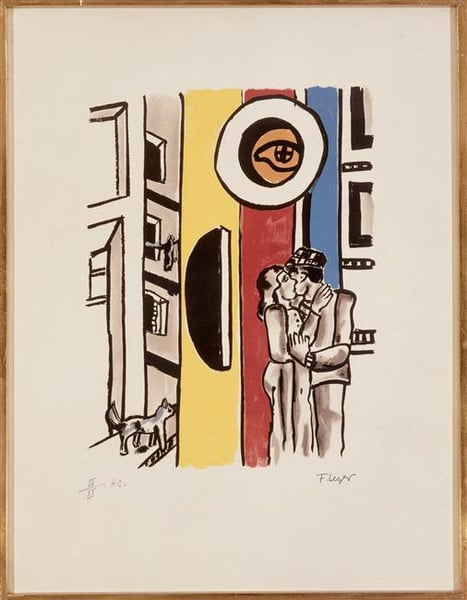
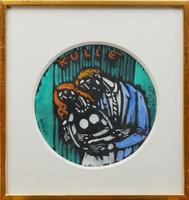
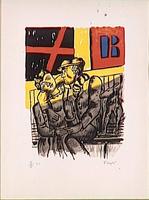
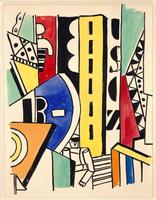
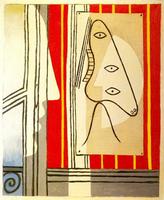
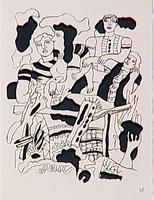
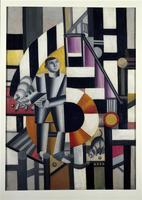
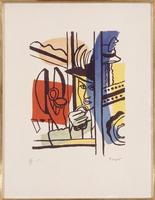
As a sketch and study within the Purist movement, Fernand Léger's "Lovers in the Street" holds significance by demonstrating how Purist principles—clarity, geometric order, and the celebration of modern machine-age forms—could be applied to intimate human subjects within an urban setting. Unlike finished Purist works that often idealize industrial objects with polished precision, this study reveals Léger's process of distilling the human figure and street environment into essential, simplified shapes. The work’s focus on lovers suggests an attempt to reconcile emotion and mechanized modernity, while its preparatory nature highlights the movement’s emphasis on disciplined composition and structural harmony. As a rare glimpse into Léger’s working method within the short-lived Purist period, it underscores how the style translated everyday life into a vocabulary of pure forms and balanced volumes, bridging figuration and abstraction.