Analisi esperta di Coney Island II di Richard Lindner
Stile: Mechanistic Cubism · Genere: figurative
Expert Analysis of Coney Island II by Richard Lindner
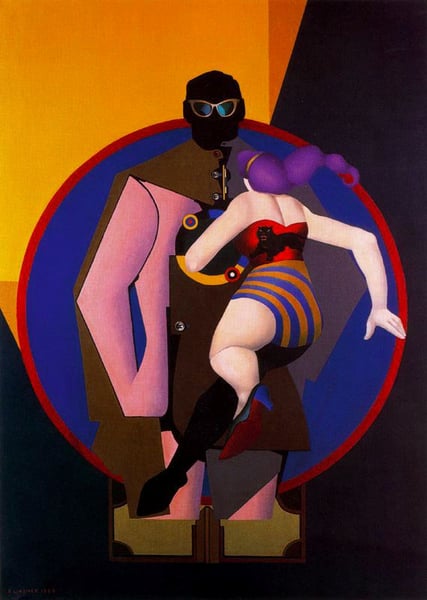
Richard Lindner’s Coney Island II stands as a compelling example of Mechanistic Cubism, a stylistic fusion that reimagines the human figure through the lens of industrial geometry and fragmented form. In this work, Lindner takes the figurative genre—a depiction of the iconic Coney Island amusement park—and subjects it to a systematic, almost robotic deconstruction. The result is a painted world where flesh and machinery become one, mirroring the early 20th-century fascination with speed, technology, and the dehumanization of modern leisure.
The significance of Coney Island II lies in how it pushes Cubist principles beyond still life and portraiture into the realm of the mechanized body. Where traditional Cubism fractured objects to reveal multiple perspectives, Lindner’s Mechanistic Cubism imposes rigid, tubular forms and sharp, angular planes that suggest cogs, pistons, and metallic armatures. The figures—likely bathers or carnival-goers—are reduced to geometric segments, their poses stiff and puppet-like, as if they are part of the park’s rides rather than autonomous humans. This treatment directly responds to the era’s anxiety about mass entertainment and the assembly-line culture of early 20th-century America.
Within the Mechanistic Cubism movement—a niche but potent offshoot of analytic and synthetic Cubism—Coney Island II achieves a rare synthesis: it retains the recognizable subject matter of the figurative tradition while transforming it into a commentary on industrial society. The work’s significance is thus twofold: it exemplifies Lindner’s signature technique of fusing Cubist fragmentation with an almost industrial hardness, and it captures the paradox of Coney Island itself—a place of pleasure where human spontaneity is subsumed by mechanical rhythms. In doing so, Coney Island II becomes a landmark in Modernist portraiture, bridging the gap between avant-garde abstraction and social critique.
Visivamente simili
20 opere con composizione e palette affini
Untitled
Richard Lindner
Untitled No. 2
Richard Lindner
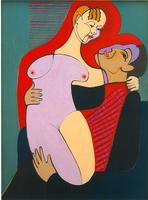
Great Lovers (Mr and Miss Hembus)
Ernst Ludwig Kirchner
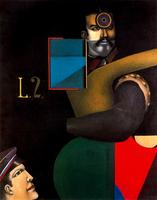
Louis II
Richard Lindner
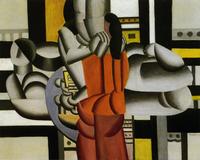
Three women with the still life
Fernand Leger
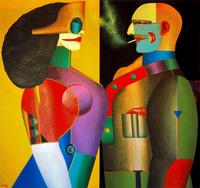
The Couple
Richard Lindner
The Secret
Richard Lindner
Two
Richard Lindner
The table
Richard Lindner
Lovers (The Hembusses)
Ernst Ludwig Kirchner
Contact
Richard Lindner
Woman
Richard Lindner
Napoleon Still Life
Richard Lindner
Mask. For the Ballet Studio of B.Nizhinskaya
Vadym Meller
Dancing Woman
Victor Palmov
The bear dance at the Moulin Rouge
Gino Severini
Jitterbugs (III)
William H. Johnson
Mannequin (Barcelona Mannequin)
Salvador Dali
Advertisment for "Norine"
Rene Magritte
Mask Dance
Ernst Ludwig Kirchner