Analisi esperta di Mural di Fernand Leger
Stile: Orphism · Genere: abstract
Expert Analysis of "Mural" by Fernand Léger
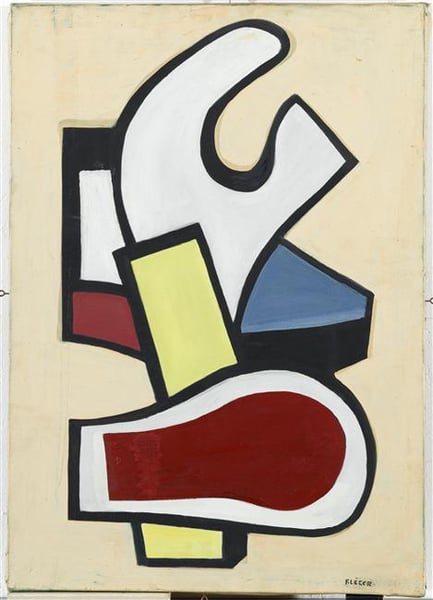
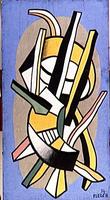
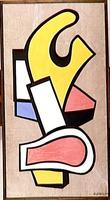
As an abstract work within the Orphist style, Fernand Léger’s "Mural" stands as a seminal example of early 20th-century modernism’s shift toward pure visual rhythm and chromatic dynamism. Orphism—coined by Guillaume Apollinaire—sought to break free from the representational constraints of Cubism by emphasizing luminosity, color contrasts, and circular, lyrical form. Léger, while often grouped with the Purists and Cubists, infused his compositions with a machine-age vitality that sets "Mural" apart.
Significance within Orphism and Abstract Art:
-
Industrial Geometric Abstraction – Unlike the more organic, swirling forms of Robert Delaunay (the central Orphist), Léger’s "Mural" employs crisp, geometric shapes that evoke mechanical parts: cylinders, discs, and interlocking planes. This reflects his belief that modern art should mirror the rhythm of urban and industrial life. The painting’s title itself signals a shift from the easel to the wall, emphasizing public, architectural scale.
-
Bold, Unmodulated Color – Léger uses flat, saturated primaries and secondary colors (red, yellow, blue, black, white) without shading. These colors are deployed in stark contrast, creating a sense of motion and depth without illusionistic perspective. This approach aligns with Orphist theory that color alone can generate pictorial space and emotional intensity.
-
Synthesis of Figuration and Abstraction – Although classified as abstract, "Mural" retains echoes of Léger’s earlier figurative works: tubular limbs, mechanical silhouettes, and human-machine hybrids. However, these forms are pushed to near-total abstraction, making the work a bridge between his representational "tubist" phase and his later, fully non-objective compositions.
-
Monumentality and Public Art Vision – Léger envisioned art as part of everyday life—accessible, large-scale, and integrated into architecture. "Mural" exemplifies this democratic ideal: its bold, simplified shapes and high-contrast palette ensure legibility from a distance, anticipating his later mosaic and mural projects for public buildings.
Art-Historical Impact:
"Mural" encapsulates Léger’s unique contribution to Orphism: not merely a lyrical color abstraction, but a hard-edged, industrial lyricism that prefigures Abstract Expressionism’s scale and Pop Art’s bold graphic vocabulary. It demonstrates how early abstraction could retain a vital connection to the modern world—machines, speed, and mass culture—while achieving pure formal autonomy.
Museum / Gallery
Visivamente simili
20 opere con composizione e palette affini
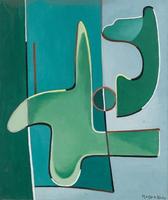
Mystere vert
Alberto Magnelli
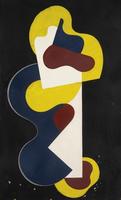
Composition Tight Curves. 25
Carl Buchheister
Figure Cubiste
Albert Gleizes
Mural
Fernand Leger
Composition
Albert Gleizes
Abstract Composition
Maurice Esteve
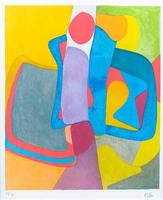
Abstract Composition
Maurice Esteve
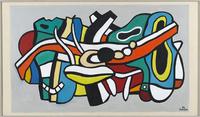
Project for a mural
Fernand Leger
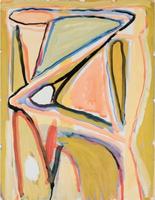
Composition
Bram van Velde
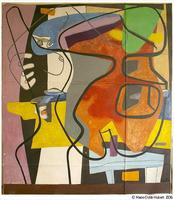
Peinture murale, 35 rue de Sèvres à Paris
Le Corbusier
Sur fond gris n. 10
Alberto Magnelli
Pure Myth
Perle Fine
Composition
Janos Mattis-Teutsch
With Premeditation
Alberto Magnelli
Study for a Painting
Ad Reinhardt
Mechanical Elements on red background
Fernand Leger
Mural
Fernand Leger
Abstraccion No. 3
Martha Boto
Points D'Hostilite No. 2 A
Alberto Magnelli
Organization
Arshile Gorky