Analisi esperta di People framework (Manufacturers) di Fernand Leger
Stile: Naïve Art (Primitivism) · Genere: portrait
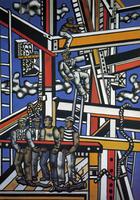
Expert Analysis: "People framework (Manufacturers)" by Fernand Léger
Style & Period Context:
Although Fernand Léger is historically aligned with Cubism, Purism, and machine-age modernism, this work is classified here under Naïve Art (Primitivism). Naïve Art typically eschews academic perspective and naturalistic detail in favor of flat, simplified forms, bold outlines, and a direct, almost childlike visual language—often celebrating everyday life and labor. Primitivism in early 20th‑century art sought to capture an “authentic,” unrefined expressiveness inspired by non‑Western or folk traditions.
Significance within the Style:
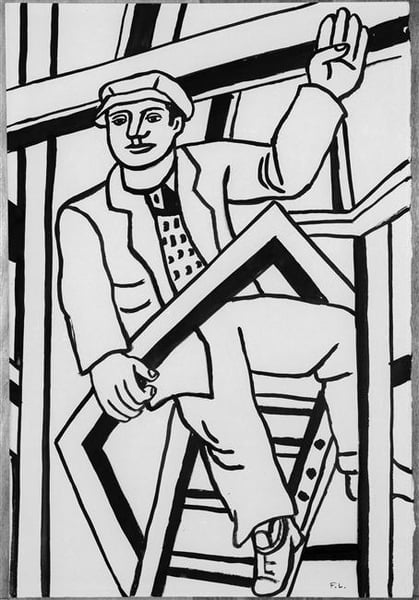
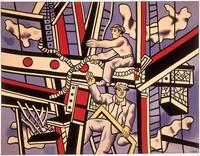
“People framework (Manufacturers)” stands out as a portrait that reimagines industrial workers using the formal strategies of Naïve Art. Instead of mechanical precision or Cubist fragmentation (Léger’s usual approach), the composition reduces human figures to elemental, almost schematic shapes—a “framework” of cylindrical limbs and blocky torsos, painted with flat, unmixed colors and heavy black contours. This simplification evokes the unschooled freshness of vernacular painting while still conveying the repetitive, structured nature of factory labor. The work thus bridges modernist simplicity and naïve sincerity, making it a rare instance where a trained avant‑garde artist deliberately adopts a primitive aesthetic to honor the dignity of manual work.
Key Artistic Choices:
- Bold, unmodulated color: Primary tones dominate, unsoftened by shading, reinforcing a direct, unmediated visual impact.
- Stiff, hieratic poses: Figures stand frontally and symmetrically, like totems or toys, which aligns with Naïve Art’s rejection of naturalistic movement.
- Framing as “people framework”: The title itself suggests that the human subject is both the content and the structural armature of the composition—a concept realized through the repetition of simple vertical and horizontal lines that echo factory scaffolding.
Why It Matters:
In Léger’s broader oeuvre, this painting is noteworthy for its deliberate stylistic departure—a conscious turn toward the vernacular to explore themes of industrialization. It demonstrates that Naïve Art was not merely the product of untrained artists but could be strategically adopted by modernists to critique or celebrate modern life. Here, the portrait genre is transformed into a monument to the collective worker, rendered with a purity of form that makes the “manufacturers” both universal and iconic. The work thus challenges the boundary between “high” and “low” art, confirming Naïve Art’s power to distill complex modern subjects into timeless, emblematic images.
Museum / Gallery
Visivamente simili
20 opere con composizione e palette affini
Builder, character in the framework
Fernand Leger
Manufacturers with Aloe
Fernand Leger
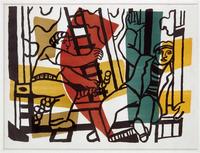
The Builders (outside color)
Fernand Leger
Illustration for Sașa Pană's „the romanticised life of god”
Jean David
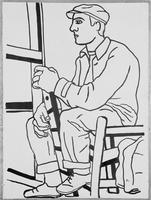
The workman sitting
Fernand Leger
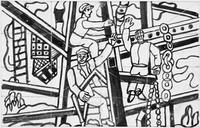
Study for builders
Fernand Leger
Howard and The Book of Life
Howard Finster
Scheiber Hugó Könyöklő Férfi
Scheiber Hugó
Manufacturers on a blue background
Fernand Leger
The man with the pipe
Fernand Leger
Manufacturers
Fernand Leger
A poet
Marc Chagall
Scheiber Hugó, Könyöklő Csvargó
Scheiber Hugó
Scheiber Hugó, Ülő Férfi
Scheiber Hugó
Mechanical Elements on a blue background
Fernand Leger
Scheiber Hugó, Asztalnál Ülő
Scheiber Hugó
Alexei Kruchenykh
Mikhail Larionov
Manufacturers on a blue background
Fernand Leger
Illustration for review "Troyer/Courant"
Marc Chagall
Scheiber Hugó, Bonviván 1922
Scheiber Hugó