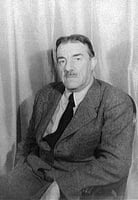
Analisi esperta di The workman sitting di Fernand Leger
Stile: Naïve Art (Primitivism) · Genere: portrait
Expert Analysis: "The Workman Sitting" by Fernand Léger
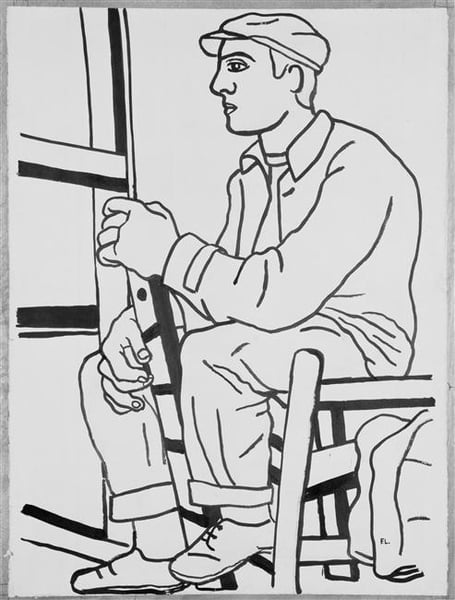
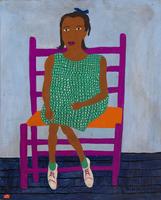
While Fernand Léger is best known for his Cubist and machine-age abstractions, "The Workman Sitting" stands as a striking departure—a deliberate foray into Naïve Art (Primitivism) that reframes his obsession with the modern worker through a deceptively simple, folk-art lens. This portrait is significant precisely because it merges Léger’s signature concern for the dignity of labor with a raw, unacademic visual language rarely seen in his mature oeuvre.
Stylistic Significance: Primitive Simplicity vs. Mechanical Precision
Léger typically rendered his figures as tubular, metallic constructs—humans fused with machinery. Here, he abandons that mechanical vocabulary. The workman is rendered with flat, unmodulated colors, a rudimentary contour line, and a childlike lack of perspective. The face is a near mask, the body a blocky silhouette. This is not the artist’s attempt to paint like an untrained amateur; it is a calculated primitivism—a stripping away of Cubist fragmentation to emphasize a more universal human presence. The rough, earthy palette (ochre, blue, black) and the simplified space evoke Le Douanier Rousseau’s naïveté, but Léger injects a sense of monumentality: the sitter fills the canvas, his hands oversized, his posture stable. This tension between primitivism and monumental portraiture makes the work a unique bridge between early modernism’s fascination with the "naïve" and Léger’s own social realism.
Subject and Genre: The Worker as Icon
As a portrait, "The Workman Sitting" does not aim for psychological depth. Instead, the figure becomes a type—the Everyman of industrial society. Léger’s working-class subjects were always central to his art; he believed the machine age had created a new kind of hero. By choosing a naïve style, he aligns that hero with folk traditions, suggesting that the worker’s truth is more fundamental than academic or avant-garde artifice. The workman’s direct, unblinking gaze and solid, immobile form convey strength and endurance. The absence of tools or factory settings (only a suggestion of a background) universalizes him: he is not just a laborer but a human archetype, rendered with the sincerity of a primary-school drawing.
Significance Within Modernism
This painting is crucial for understanding Léger’s broader project. It challenges the assumption that Primitivism is only about "exotic" or "tribal" sources. Here, the primitive is the working-class body itself—bold, unpolished, authentic. In an era when Cubism and abstraction were becoming increasingly intellectual, Léger’s self-conscious turn to Naïve Art acts as a corrective, asserting that the most powerful modern art can also be the most direct. The work anticipates later Pop Art’s embrace of simplified, iconic imagery, yet retains a humanist gravity that Pop would later subvert with irony.
Conclusion: "The Workman Sitting" is significant as a deliberate, sophisticated primitivism that redefines Léger’s machine-age aesthetic. It transforms a humble sitter into a timeless, almost symbolic figure, using the language of childlike drawing to speak with profound gravity. In this portrait, Léger proves that “naïve” does not mean simplistic—it means essential.
Museum / Gallery
Visivamente simili
20 opere con composizione e palette affini
Builder, character in the framework
Fernand Leger
People framework (Manufacturers)
Fernand Leger
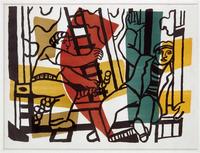
The Builders (outside color)
Fernand Leger
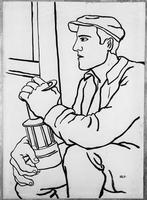
A worker with the lamp
Fernand Leger
Sheet with People Sitting on Chairs
Vincent van Gogh
The Young Sailor II
Henri Matisse
Portrait de Max Jacob
Christopher Wood
Captain Vangelis
Spyros Vassiliou
Old Man Reading
Vincent van Gogh
Man Sat on Chairs
Billy Childish
Boy In Red Jacket
Louay Kayyali
Study for builders
Fernand Leger
The Studio
Georges Braque
Scheiber Hugó , Zöld Ruhás Férfi
Scheiber Hugó
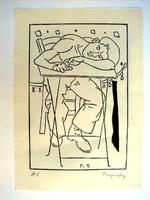
Sketch
Yiannis Tsaroychis
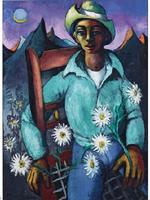
Lot 295 JM
Johannes Meintjes

Jean
Alex Katz
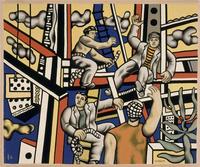
Manufacturers with Aloe
Fernand Leger
La Cueillette Des Fruits
Bela Czobel
Anna Mae
William H. Johnson