Expert analysis of Fernand Leger’s Soldiers
Style: Naïve Art (Primitivism) · Genre: sketch and study
Expert Analysis of "Soldiers" by Fernand Léger
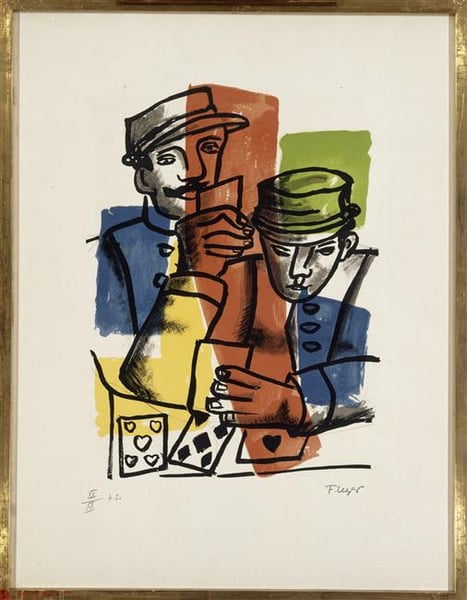
Fernand Léger’s Soldiers occupies a unique position within his early oeuvre, bridging his experiments with Cubist fragmentation and the raw, unpretentious energy of Naïve Art (Primitivism). As a sketch and study, this work foregrounds Léger’s interest in the essential, almost elemental depiction of the human figure—a concern that would later crystallize in his signature “tubular” style.
Significance within the Primitivist Context
While Léger is most celebrated for his mechanized, industrial forms of the 1920s onward, Soldiers reveals his engagement with Primitivism’s rejection of academic refinement. The sketch’s deliberate flatness, bold outlines, and simplified anatomy echo the directness of folk art and non-Western carving. Here, Léger strips combatants of psychological depth, reducing them to archetypal, blocky silhouettes. This aligns with Primitivism’s search for a visceral, pre-modern vitality—a contrast to the polished naturalism then dominant in French painting.
Role as a Sketch and Study
The work’s significance is heightened by its status as a study. Léger uses rapid, visible lines and minimal shading to explore volume and movement, as if testing how far form can be condensed without losing legibility. The soldiers’ stances are almost cartoonish, yet their mass and weight are conveyed through clustered, cylindrical body parts. This preparatory quality offers a rare glimpse into Léger’s process: he is not documenting war but distilling its physical tension into pure visual rhythm. The sketchiness itself becomes a statement—a rejection of finished, illusionistic space in favor of an unfiltered, even crude, expressive force.
Transitional Importance
Soldiers marks a pivotal moment between Léger’s earlier Impressionist landscapes and his fully realized Cubo-Futurist works (e.g., The City, 1919). The flattened, overlapping figures anticipate his later fascination with modern machinery, but here they retain a more organic, almost tribal awkwardness. This hybridity—where modern subject matter meets archaic treatment—makes the sketch a key document of Léger’s struggle to reconcile the human with the industrial, the naïve with the avant-garde.
In sum, Soldiers is significant for its unpolished distillation of Primitivist ideals, its insight into Léger’s formal experimentation, and its role as a hinge between his early naturalism and his mature mechanical aesthetic.
Museum / Gallery
Visually similar
20 works with related composition and palette
Album Le Cirque
Fernand Leger
The album "Circus"
Fernand Leger
The Ace of Clubs
Richard Lindner
Stepping out
Roy Lichtenstein
The album "Circus"
Fernand Leger
Card trick
Andre Masson
Nozdryov and Tchitchikov
Marc Chagall
There was a dispute going on between the executioner, the King, and the Queen
Charles Robinson
The Card Players
Theo van Doesburg
Kaartspelers - DinksFãStan Private Collection
Conrad Theys
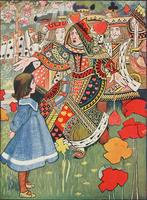
Off with her head
Charles Robinson
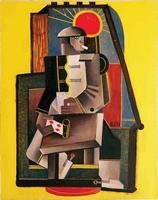
Soldat
Gosta Adrian-Nilsson
El Al Playing Cards
Jean David
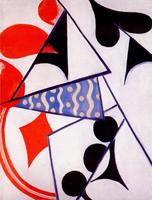
Four aces (Simultaneous Composition)
Olga Rozanova
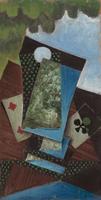
Ace of Clubs and Four of Diamonds
Juan Gris
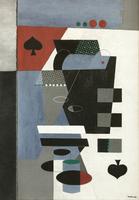
The Queen of Spades
Toyen
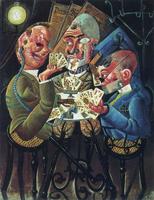
The Skat Players
Otto Dix
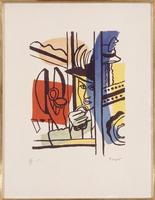
Women in compact
Fernand Leger
Magus Flames Novalis
The Game of Marseille
Siren Locks Helene Smith
The Game of Marseille