
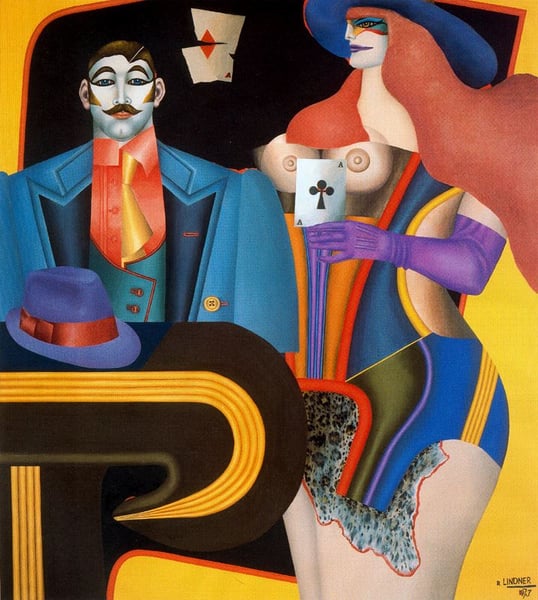
Expert analysis of Richard Lindner’s The Ace of Clubs
Style: Mechanistic Cubism · Genre: genre painting
Expert Analysis: "The Ace of Clubs" by Richard Lindner
Style & Period Context
This work exemplifies Mechanistic Cubism, a fusion of Cubist fragmentation with the rigid, geometric forms of machinery. Lindner’s approach pushes beyond traditional Cubism by replacing organic planes with industrial, almost robotic shapes—a hallmark of his unique vision. The genre painting (depicting everyday life) is transformed into a cool, analytical scene, where human figures and objects are reduced to interlocking, machine-like components. This merging of the mundane with the mechanical underscores the artist’s commentary on modern alienation and the dehumanizing influence of technology.
Significance Within Mechanistic Cubism
- Formal Innovation: Lindner applies Cubist spatial disassembly (multiple viewpoints, flattened depth) to a distinctly mechanical vocabulary. The “club” motif—likely a playing card or symbolic emblem—is rendered as a precise, angular emblem, echoing both Cubist grid structures and industrial design.
- Genre Reinterpretation: Rather than a warm, anecdotal genre scene, Lindner presents a stark, dispassionate tableau. The figures (if present) appear as automata, stripped of emotion, emphasizing the tension between human activity and mechanized existence.
- Period Relevance: Created during a mid-20th-century moment of rapid technological change, the work critiques the absorption of human identity into systematic, machinic order. It stands as a key example of how Cubist principles could be redirected toward a critical, modern sensibility.
Conclusion
“The Ace of Clubs” is significant for its bold synthesis of Cubist analysis and mechanical geometry, turning a traditional genre painting into a provocative statement on the industrialized human condition. Lindner’s Mechanistic Cubism here achieves a powerful formal and thematic coherence.
Museum / Gallery
Visually similar
20 works with related composition and palette
Soldiers
Fernand Leger
Nozdryov and Tchitchikov
Marc Chagall
The Skat Players
Otto Dix

Stepping out
Roy Lichtenstein

Solitaire
Richard Lindner
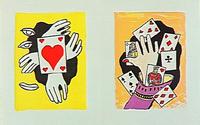
Album Le Cirque
Fernand Leger
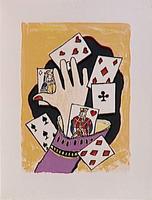
The album "Circus"
Fernand Leger
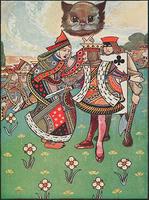
There was a dispute going on between the executioner, the King, and the Queen
Charles Robinson
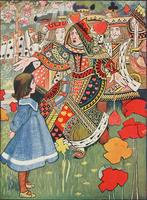
Off with her head
Charles Robinson
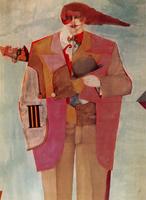
A Letter from New York
Richard Lindner

All on a Summer's Day
Alexandrea Nicholas-Jennings
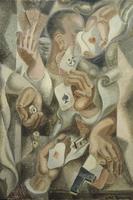
Card trick
Andre Masson
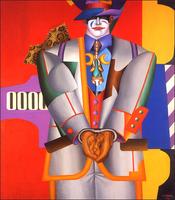
F B I On East69th Street
Richard Lindner

Four aces (Simultaneous Composition)
Olga Rozanova
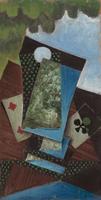
Ace of Clubs and Four of Diamonds
Juan Gris
The Queen of Spades
Toyen
The album "Circus"
Fernand Leger

The Card Players
Theo van Doesburg
Dresdens spektrum: Spader Ess
Otto Gustav Carlsund
El Al Playing Cards
Jean David