Analisi esperta di Still Life di Fernand Leger
Stile: Cubism · Genere: still life
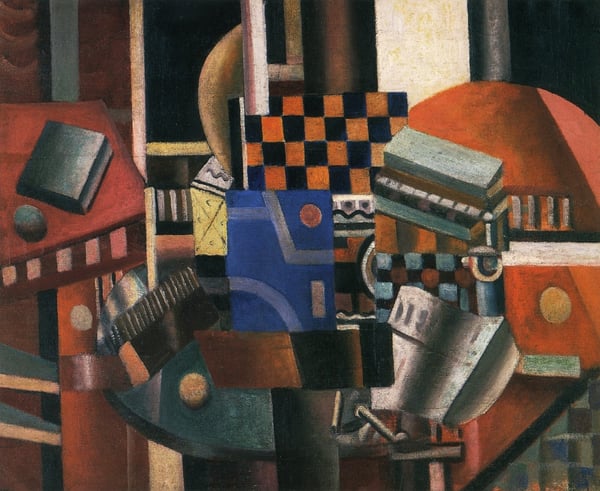
Fernand Léger’s Still Life stands as a pivotal example of how Cubism could be reinvented through a distinctly modern, industrial lens. While the genre of still life was a favorite among Cubists—offering a static arrangement of objects for formal deconstruction—Léger diverges from the more muted, analytical approach of Picasso and Braque. Instead, he infuses the composition with a bold, machined energy.
Significance within Cubism and Léger’s Oeuvre:
- Tubular Forms and Mechanical Precision: Léger famously reduced objects to their essential cylindrical and geometric components—what critics later called “tubism.” In this Still Life, bottles, fruits, or tabletops are likely rendered as stacked, intersecting pipes and disks. This technique mirrors the industrialized world of gears, pistons, and machinery, setting Léger apart from the more organic or fragmentary facets of Analytical Cubism.
- Vibrant, Contrasting Palette: Where early Cubism often employed subdued browns, grays, and ochres, Léger introduces primary colors (reds, blues, yellows) and stark black outlines. This chromatic boldness, combined with the flat, poster-like clarity of the forms, anticipates both Purism and his later “mechanical period.” The result is a still life that feels less like a quiet tabletop arrangement and more like a dynamic, urban collision of parts.
- Rejection of Depth for Surface Tension: The composition flattens space, stacking volumes vertically and horizontally without traditional perspective. Yet Léger retains a sense of sculptural weight—his objects are not shattered into facets but remain fully rounded, creating a tension between two-dimensional surface and three-dimensional mass. This balance between abstraction and recognizable objecthood makes the work a bridge between Cubist experimentation and Léger’s own unique vision of a “modern classicism.”
- The Still Life as a Stage for Modernity: For Léger, the humble still life became a testbed for his belief that art must reflect the rhythm of modern life. The fragmented, overlapping shapes in Still Life evoke the simultaneous viewing of multiple angles—a visual analogue of the speed and multiplicity of the machine age.
In short, this artwork is significant because it redefines Cubist still life not as a quiet study of form, but as a loud, colorful, and engineered manifesto for a new visual language fit for the 20th century.
Museum / Gallery
Visivamente simili
20 opere con composizione e palette affini
Towers
Max Ernst
The typographer
Fernand Leger
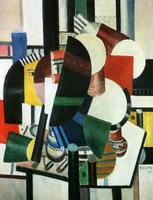
Woman with flower portrait study
Fernand Leger
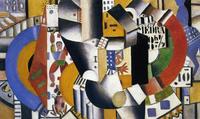
The Circus
Fernand Leger
Station Without a Stop. Kunzevo.
Kazimir Malevich
Window opened to the street Penthieure
Pablo Picasso
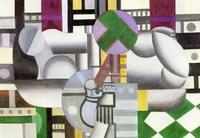
The birds in the landscape
Fernand Leger
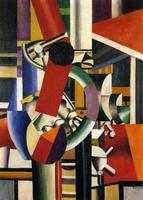
Still life
Fernand Leger
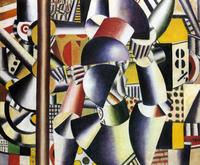
Acrobats in the circus
Fernand Leger
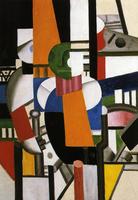
The Man with the cane
Fernand Leger
Factories
Fernand Leger
The Disc
Fernand Leger
Composition
Fernand Leger
Still Life With Pumpkin and Bottle of Rum
Jean Metzinger
Guard
Kazimir Malevich
Man with guitar
Pablo Picasso
Three figures
Fernand Leger
The Stove
Fernand Leger
The lady at the piano
Kazimir Malevich
Naturaleza Muerta
Maria Blanchard