Expert analysis of Fernand Leger’s The Circus
Style: Cubism · Genre: abstract
Artwork Analysis: The Circus by Fernand Léger (Cubism – Abstract)
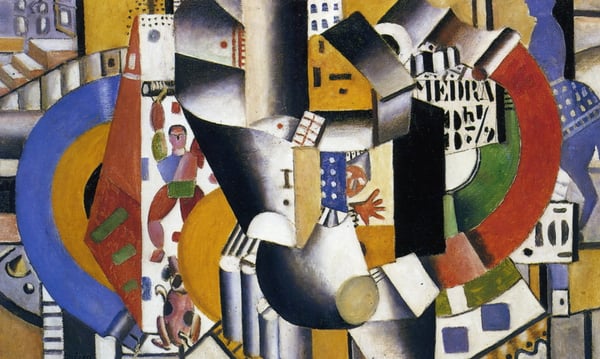
Fernand Léger’s The Circus stands as a vibrant, landmark work within the Cubist movement, distinguished by its bold departure from traditional representation and its embrace of mechanized, abstract forms. As an abstract composition, the painting translates the dynamic energy of the circus—its performers, animals, and spectators—into a rhythmic interplay of geometric shapes, tubular volumes, and flat planes of primary color.
Significance within Cubism:
Léger was a key figure in the development of Cubism, but he pushed the style beyond the analytical fragmentation of Picasso and Braque. In The Circus, he synthesizes Cubist structure with a modern, industrial aesthetic. The figures are reduced to simplified cylinders, cones, and arcs—a visual language Léger called “the beauty of the machine.” This abstraction is not merely formal; it reflects the artist’s fascination with the speed, noise, and spectacle of contemporary urban life, using the circus as a metaphor for a new, technologically driven society.
Key Characteristics:
- Bold color contrast: Léger employs flat, unmodulated reds, yellows, blues, and black outlines, creating a sense of rhythm and movement that mimics the circus’s chaotic energy.
- Overlapping, shallow space: Unlike traditional perspective, the composition jumbles acrobat limbs, rings, and stage elements on a single plane, forcing the viewer to read the scene as a visual puzzle.
- **Mechanistic forms: ** Human bodies are rendered as metallic, jointed parts, emphasizing the dehumanizing yet exhilarating pace of modernity.
Why It Matters:
The Circus is significant because it demonstrates how Cubism evolved from an analytical tool into a poetic, abstract language capable of capturing the spirit of the age. Léger’s work bridges Cubism and later movements like Purism and Pop Art, proving that abstraction could be both intellectually rigorous and joyfully accessible. The painting remains a seminal example of how modernist art redefined perception—not by copying reality, but by reconstructing it through the lens of industrial dynamism and pure visual sensation.
Visually similar
20 works with related composition and palette
Man and Woman
Fernand Leger
The Stove
Fernand Leger
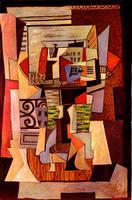
Window opened to the street Penthieure
Pablo Picasso
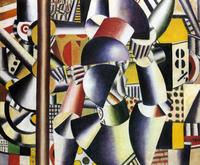
Acrobats in the circus
Fernand Leger
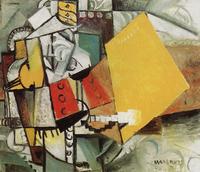
Guard
Kazimir Malevich
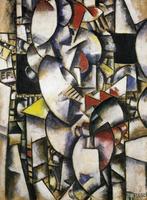
Naked model in the workshop
Fernand Leger
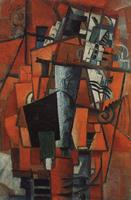
The lady at the piano
Kazimir Malevich
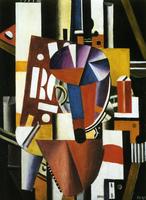
The typographer
Fernand Leger
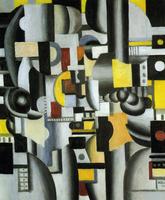
Composition
Fernand Leger
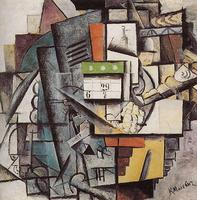
Lady on a Tram Station
Kazimir Malevich
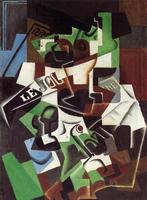
Fruit Bowl, Pipe and Newspaper
Juan Gris
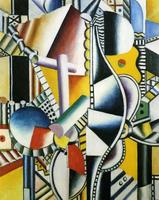
Propellers 2nd state
Fernand Leger
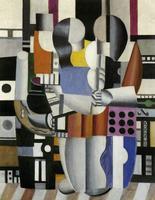
Three figures
Fernand Leger
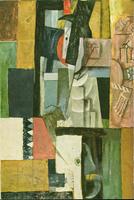
Man with guitar
Pablo Picasso
Vanity Box
Kazimir Malevich
Bureau and Room
Kazimir Malevich
Composition
Georges Valmier
Women with Mirror
Fernand Leger
Bottle of Beaune and a Fruit Dish
Juan Gris
City at Night
Aleksandra Ekster